



AI Researchers Advance Noise Injection Defences With New 2022–2025 Techniques
Noise-injection techniques are emerging as a key area of research for strengthening AI systems against adversarial attacks. Recent methods — including PNI, AdaNI, DiffPure, ADBM and MANI-Pure — combine adaptive noise, diffusion purification and feature-aware strategies to enhance both model robustness and clean accuracy.

AI Browsers Exposed: 4 Major Prompt-Injection Flaws Hit ChatGPT Atlas and Perplexity Comet
Researchers have uncovered four major prompt-injection attack vectors affecting both ChatGPT Atlas and Perplexity Comet, revealing systemic weaknesses across AI-powered browsers. Hidden webpage instructions, screenshots, malformed URLs and tainted agent memory can all trigger unintended actions. The findings indicate that architectural changes are needed as AI browsers become more autonomous.

EY Launches AI Academy After Upskilling 44,000 Staff and Piloting 50+ Enterprise Projects
EY has launched its AI Academy in New Delhi to address rising demand for enterprise AI skills. Built on 200+ real-world use cases, the programme follows EY’s internal upskilling of 44,000 employees and pilots with five organisations, which generated over 50 AI projects. The initiative aligns with India’s rapid growth in generative AI learning.

KU Leuven Concludes 5-Year AI Law & Ethics Summer School as EU Act Enters Full Force
KU Leuven has concluded its five-year Summer School on the Law, Ethics and Policy of Artificial Intelligence, held in hybrid format in July 2025. The programme brought together academics, policymakers and practitioners to examine regulatory, ethical and practical dimensions of AI, including the EU’s AI Act. Participants explored global governance trends, sector applications, and emerging questions in responsible AI deployment.

AI SDKs in 2025: How Software Development Kits Are Shaping the Next Wave of Intelligent Systems
Software development kits have moved from supporting tools to strategic enablers in the AI development landscape. By providing compilers, libraries, sample code, and deployment utilities, they streamline workflows across cloud, edge, and mobile environments. Recent AI-focused SDK releases illustrate how vendors are addressing integration challenges as systems grow more complex. At the same time, questions around standardisation, transparency, and security continue to shape how these tools are adopted.
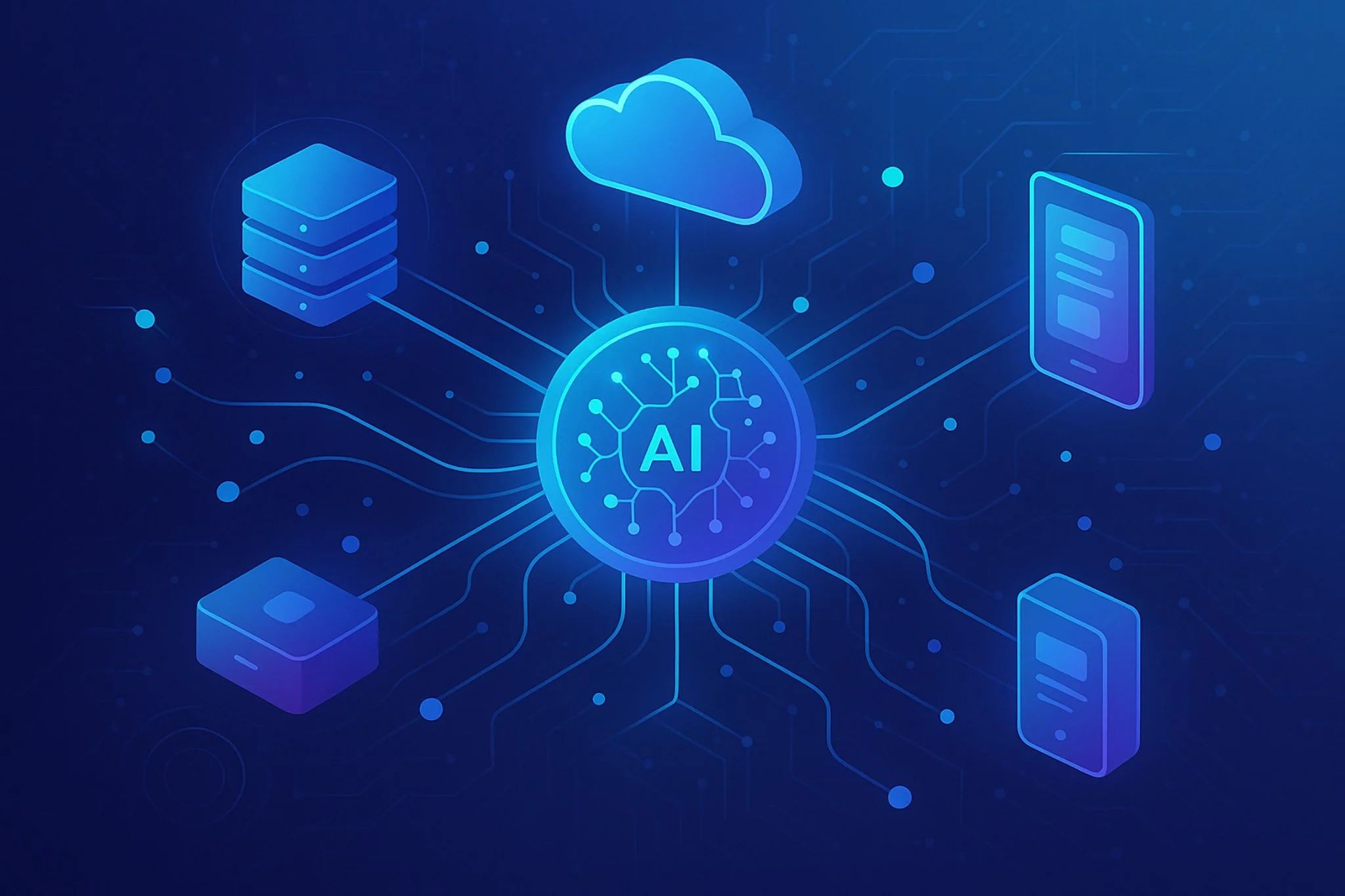
JSON-RPC’s Role in AI: How a 2005 Web Standard Became a Key Link for Modern Model Systems
JSON-RPC is a lightweight communication protocol that continues to play an important role in AI and distributed computing. Its simple request-and-response structure, transport flexibility, and compatibility with systems such as the Model Context Protocol and blockchain clients have supported its ongoing use. This report reviews its development, applications, benefits, and future outlook.

MCP Nears One Year: Anthropic’s Open Protocol Becomes Key Standard for Connected AI Systems
Anthropic’s Model Context Protocol (MCP) is gaining momentum as an open standard for linking AI models to live data and external tools. By simplifying integrations and enhancing interoperability, MCP is reshaping how AI systems perform real-world tasks across sectors from software development to business operations.

Microsoft Launches NLWeb to Bring AI Conversational Agents to Websites
Microsoft has unveiled NLWeb, an open-source framework designed to integrate conversational AI directly into websites. Announced at Build 2025, NLWeb uses standards such as Schema.org and the Model Context Protocol to allow users and AI agents to query content in natural language. The initiative aims to make websites AI-responsive, interoperable, and better prepared for an emerging agentic web.

Agent Network Protocol Emerges as Open-Source Standard for AI Agent Interoperability
The Agent Network Protocol (ANP) has been introduced as an open-source standard for AI agent interoperability, offering a three-layer architecture for secure communication, authentication, and discovery. Developed by a community-led initiative and formalized in a July 2025 arXiv paper, ANP seeks to address fragmentation in agent ecosystems by adopting semantic web technologies and decentralized identifiers.

Emergence of the Agentic Internet: AI Agents Reshape Online Interactions
The “agentic internet” is redefining how people and AI interact online. In 2025, Microsoft and industry partners introduced open protocols, AI tools, and platforms that enable autonomous agents to plan, reason, and collaborate across the web. These systems promise greater efficiency and innovation while raising new challenges around governance, monetization, and ethics.

Finix-S1-32B Hits 0.6% Hallucination Rate as Mid-2025 AI Accuracy Rankings Shift
New mid-2025 benchmarks reveal significant variation in factual accuracy across leading AI models. AntGroup’s Finix-S1-32B records a 0.6% hallucination rate on Vectara tests, the lowest publicly measured result, while models from Google, OpenAI, Anthropic and xAI show differing strengths across reasoning, summarisation and verification tasks.

Understanding Optimization in AI: Techniques, Evolution, and Future Prospects
Optimization lies at the heart of artificial intelligence, enabling models to refine parameters, reduce errors, and adapt to complex tasks. Tracing its roots from early mathematics and linear programming to modern techniques like Adam and neural architecture search, this report explores how optimization drives AI progress, industry applications, and emerging future directions.

OpenAI GPT-5 Pro Scores 100% on AIME 2025 Math Exam
OpenAI's GPT-5 model advances AI capabilities in math, coding, and multimodal tasks, with GPT-5 Pro achieving 100% on AIME 2025 using Python. Compared to Grok 4, Claude Opus 4.1, and DeepSeek R1, it shows versatility, supported by robust safety evaluations.

AI and Web3 Converge: Decentralized Intelligence Gains Momentum in 2025
In 2025, the convergence of artificial intelligence and Web3 is accelerating, enabling decentralized AI applications, secure data management, and automated processes. This integration is transforming key industries, addressing longstanding challenges in centralization and privacy, while raising new questions about scalability, regulation, and inclusion.

AI Agents vs Agentic AI: Key Differences Driving the Future of Autonomous Systems
This report explores the emerging distinction between AI agents and agentic AI, highlighting their differing levels of autonomy, real-world applications, and projected impact on industries such as healthcare, finance, and logistics. It also examines the benefits, challenges, and future trends shaping the evolution of intelligent systems.
OpenAI Launches ChatGPT Agent to Automate Online Tasks and Enhance Productivity
OpenAI has unveiled ChatGPT Agent, a feature designed to handle complex online tasks by integrating browsing, research, and automation tools. Initially available to paying subscribers, it aims to improve daily productivity while addressing safety, performance, and ethical considerations.

Advancements in AI Model Quantization Drive Efficiency Gains
Explore how quantization compresses AI models to reduce memory and speed up processing while minimizing accuracy loss. This report covers the technique's mechanics, historical development, benefits like lower energy use, challenges such as potential performance drops, recent innovations for large language models, future trends in adaptive methods, and its impact on edge computing and industries like healthcare.

Quantum Qubits Boost AI Efficiency with Superconducting Reservoir Computing
Researchers are exploring superconducting qubit reservoir computing as a promising quantum-enhanced method for AI. By leveraging Kerr nonlinearity and fixed dynamic systems, this approach simplifies training, reduces energy use, and shows potential in tasks such as pattern recognition and time-series forecasting.

Google Launches Gemma 3n: Compact Multimodal AI Model for On-Device Applications
Gemma 3n is Google’s latest AI model built for on-device performance across mobile and edge devices. With support for text, images, audio, and short video, it brings advanced offline AI capabilities to resource-limited hardware. Here’s a look at its features, use cases, limitations, and developer impact.

Philosophers Shape Claude AI’s Ethical Core in Anthropic’s Bold Alignment Initiative
Anthropic’s Claude AI is redefining ethical machine intelligence by incorporating philosophical guidance into its design. Led by ethicists like Amanda Askell, Rob Long, and Pat Butlin, the model leverages reinforcement learning from human feedback and constitutional AI to align with human values. A recent model welfare evaluation explores Claude’s behavior and raises critical questions about the ethical boundaries of non-sentient systems.