
Understanding Optimization in AI: Techniques, Evolution, and Future Prospects

Image Credit: Igor Omilaev | Splash
Optimization forms the foundation of artificial intelligence, allowing models to learn from data by iteratively refining parameters to reduce errors and improve efficiency. As AI systems increase in scale, these mathematical approaches remain vital for delivering precision and performance in fields from machine learning to operational planning.

























What is Optimization in AI?
Optimization in AI involves the systematic adjustment of algorithms and models to enhance their accuracy, efficiency, and resource utilization. This process uses mathematical techniques to minimize a loss function, which quantifies the gap between predicted and actual results. In machine learning, for example, optimization algorithms guide models through complex parameter spaces to reach effective solutions.
The demand for these methods arises from the difficulties in training AI models, such as managing large datasets and evading local minima in non-convex landscapes. Inadequate optimization can result in overfitting, where models excel on training data but falter on unseen inputs, or underfitting, where essential patterns are overlooked. This is particularly relevant in deep learning, where networks with extensive parameters require meticulous calibration.

























Historical Background
Optimization's origins extend to ancient mathematical inquiries, including Greek geometry circa 300 BC, where figures like Euclid addressed maximizing areas under constraints. Contemporary optimization advanced in the 20th century, with Leonid Kantorovich introducing linear programming in 1939 for resource allocation amid wartime demands, later earning the 1975 Nobel Prize in Economics. Within AI, optimization rose with neural networks. Frank Rosenblatt's perceptron in 1958 employed basic gradient updates, but its inability to manage non-linear issues contributed to the AI winter of the 1970s.
Progress resumed in 1986 with the refinement of backpropagation by David Rumelhart, Geoffrey Hinton, and Ronald Williams, facilitating gradient computation in layered networks. This enabled variants of gradient descent, becoming central to machine learning. By the 2010s, amid expanding data and computation, optimizers like Adam, created by Diederik Kingma and Jimmy Ba in 2014, integrated adaptive rates for quicker convergence on expansive datasets.
These evolutions addressed the scaling needs of AI, shifting optimization from abstract concepts to essential components in model training.

























Key Optimization Techniques
Multiple primary methods prevail in AI optimization, each tackling distinct aspects of model development and deployment.
Gradient descent and its derivatives are fundamental. Basic gradient descent shifts parameters against the loss function's gradient, though it slows on vast datasets. Stochastic gradient descent (SGD), refined from 1950s origins in the 1980s, employs random subsets for accelerated updates, despite added noise. Momentum, introduced by Boris Polyak in 1964, incorporates velocity to traverse plateaus.
Second-order techniques, like Newton's method from the 17th century adapted for AI, utilize the Hessian matrix for curvature-aware steps, yielding rapid convergence at greater computational expense. Quasi-Newton methods, such as BFGS from Charles Broyden and others in 1970, approximate the Hessian for scalability in high-dimensional tasks.
Evolutionary strategies, drawing from biology, include genetic algorithms pioneered by John Holland in the 1960s, which evolve solution populations via selection, crossover, and mutation, suited for non-differentiable challenges. Swarm-based approaches, such as particle swarm optimization by James Kennedy and Russell Eberhart in 1995, emulate collective behaviors to survey search spaces. Bayesian optimization, established in the 1990s, applies probabilistic modeling for hyperparameter tuning in costly evaluations.
Specialized methods encompass pruning to excise superfluous weights after training, quantization to lower parameter precision for device deployment, and regularization like L1/L2 penalties from the mid-20th century, adapted since the 1990s to curb overfitting by limiting parameter scales.
Selection of these techniques depends on problem size and limitations, weighing convergence speed, precision, and resource requirements.

























Recent Developments
Recent years have seen optimization adapt to generative AI and expansive language models. In 2024, AWS detailed how generative AI merges with conventional optimization to automate problem modeling and boost interpretability, using services like Amazon Q for code in supply chain scenarios. Building on this, AWS launched Kiro in July 2025, an agentic integrated development environment that employs AI agents for spec-driven coding, handling tasks from prototypes to production, including code optimization and document generation.
In the same month, AWS announced the Q Business Suite (QBS), consolidating tools such as Q Business, Q Apps, and QuickSight into a unified generative AI workspace for enterprise insights and workflows, amid a broader revamp of its AI application strategy. However, in July 2025, a security vulnerability (CVE-2025-8217) was identified in version 1.84.0 of the Amazon Q Developer VS Code extension, involving inert malicious prompt injection that could potentially wipe local and cloud resources; AWS patched it promptly without reported compromises.
Hyperparameter optimization advancements, including neural architecture search (NAS) automated from 2016, now use AI to craft networks, minimizing manual input. Transfer learning, prominent in the 2010s, refines pre-trained models to shorten training durations. Dataset distillation in 2024 compressed datasets while retaining key features, supporting efficient retraining as data volumes grow. Issues like model drift, where efficacy wanes over time, have prompted routine retraining on fresh data.
These progressions counter the surge in AI model complexity, fuelled by needs for immediate applications in sectors like healthcare and finance, while highlighting ongoing security and integration challenges.





















Impacts on AI and Industries
Optimization has significantly bolstered AI's practicality, permitting efficient handling of massive data and deployment on constrained hardware. In manufacturing, it refines schedules to lower costs substantially, as evidenced in AWS implementations. In finance, it enhances portfolio management by balancing returns and risks through predictive integrations.
Wider effects include broadening AI accessibility, with streamlined optimizers reducing entry barriers for smaller entities. Yet, high computational demands pose environmental risks, with large-model training equating to substantial household energy use. Ethically, flawed optimization may amplify data biases, calling for equitable designs. Security incidents, such as the recent AWS extension vulnerability, underscore the need for robust safeguards in AI tools to prevent potential disruptions.
Collectively, these methods have hastened AI integration, yielding economic benefits projected in the trillions. They underscore the imperative for sustainable methodologies.





























Future Trends
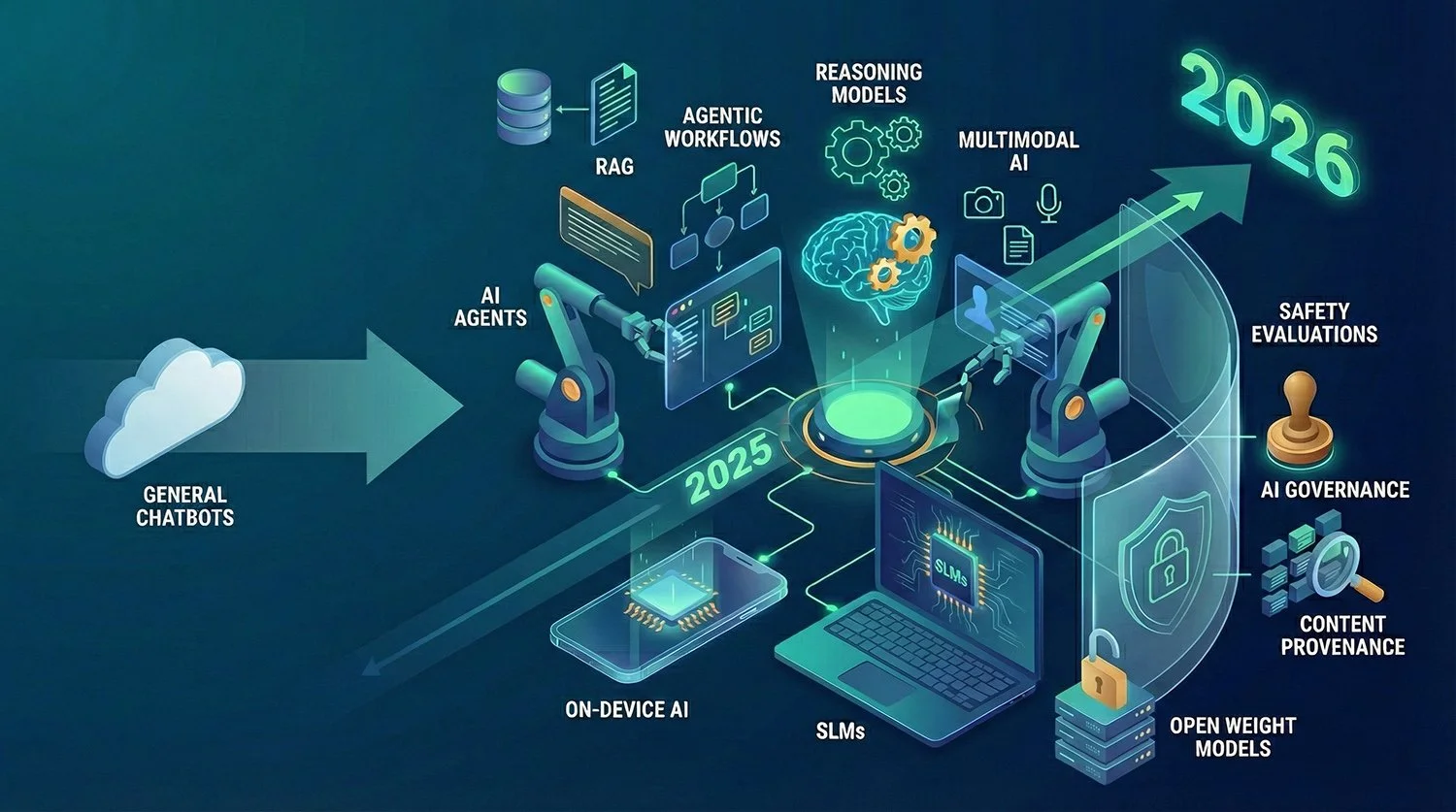
Into 2026 and later, AI optimization will emphasize scalability and eco-friendliness. With organizational AI adoption at 78% in 2024 per Stanford's AI Index, up from 55% prior, focus shifts to inference efficiency for edge and agent systems.
Emerging directions include multimodal optimization for handling diverse inputs like text and video, and agentic AI for independent decisions, as exemplified by tools like Kiro. IBM anticipates a move toward scaling with optimized existing processes, blending robotics and ethical AI. Growth in very large models will necessitate distributed techniques to control expenses.
Hurdles like data privacy, energy use, and tool security will spur green innovations and enhanced protections, potentially cutting AI's environmental footprint. Experts foresee these shifts strengthening AI in tailored healthcare and automation, promoting growth while demanding regulatory frameworks for fair outcomes.








































 TheDayAfterAI News
We are a leading AI-focused digital news platform, combining AI-generated reporting with human editorial oversight. By aggregating and synthesizing the latest developments in AI — spanning innovation, technology, ethics, policy and business — we deliver timely, accurate and thought-provoking content.