
New Artificial Neurons Mimic Biology with 60mV Signals to Cut AI Power
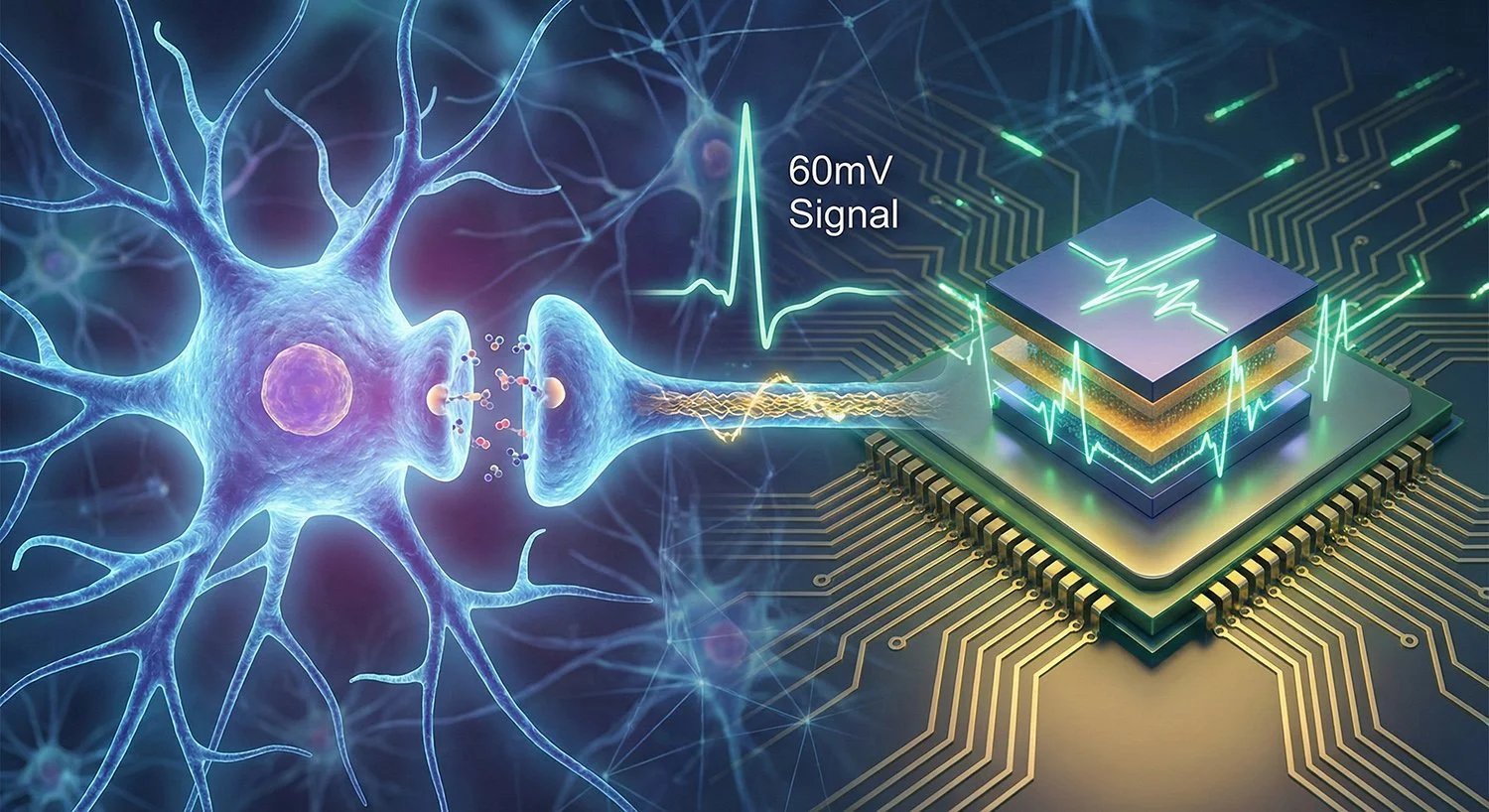
Image Credit: Jacky Lee
Researchers are reporting progress on neuromorphic components that use ion motion in memristors to reproduce parts of how neurons integrate signals and fire, a line of work aimed at cutting the power and circuit overhead of running artificial intelligence on devices such as robots, sensors and other connected systems.
























What Was Published and When
In Nature Electronics, a team described a “spiking artificial neuron” built from one diffusive memristor, one transistor and one resistor, and said the unit can be laid out to take the footprint of a single transistor when vertically integrated. The paper was published 27 October 2025 and later updated to amend a peer review statement, according to the journal’s change history.
Separately, an open access Nature Communications study published 29 September 2025 reported artificial neurons designed to better match biological ranges in signal amplitude and energy, and to be modulated by extracellular chemical species, a mechanism the authors link to neuromodulation in biology.





























How the Devices mimic Neuronal Behaviour
The Nature Electronics paper frames the gap it is trying to close: conventional complementary metal oxide semiconductor circuits can implement neuromorphic functions, but often require intricate circuitry because their native behaviour differs from neurons. The authors argue that diffusive memristors, which rely on ion dynamics, are closer in spirit to neuronal processes and can support more compact neuromorphic building blocks.
In the same paper, the researchers report six neuronal characteristics in their device level neuron model: leaky integration, threshold firing, cascaded connection, intrinsic plasticity, refractory period and stochasticity, and estimate picojoule per spike energy consumption, with further scaling potentially lowering that figure, based on their reported projections.
The Nature Communications authors describe a memristor based approach that explicitly targets biological parameter ranges. They report switching around 60 millivolts and about 1.7 nanoamps, with an “off” resistance near 200 megaohms, and they connect their artificial neuron to biological cells to process signals in real time and interpret cell states, as an example of possible bioelectronic interfacing.



























Chemical Signalling as a Design Target
A key element in the Nature Communications work is chemical modulation: the authors report that their artificial neurons can be modulated by extracellular chemical species and can be paired with chemical sensing to emulate neuromodulation by ions and neurotransmitters, in line with their framing of neuron like information flow.
The study also attributes part of its low voltage behaviour to materials choices, including prior work using protein nanowires from Geobacter sulfurreducens in an Ag based memristor to reduce operating voltage into a bio amplitude regime.
























Why it Matters for Low Power AI at the Edge
The technical promise for artificial intelligence is straightforward: if more neuron like dynamics can be implemented directly in hardware with low energy per event, systems that rely on spiking style computation could process some workloads with lower energy and potentially lower latency than conventional always on digital pipelines, particularly where data arrives as sparse events rather than continuous streams.
The USC Viterbi write up tied to the Nature Electronics result also points to a manufacturing challenge: it notes that silver used in the experiment is not readily compatible with conventional semiconductor manufacturing, and that alternative ionic species may need to be explored to achieve similar functions in more standard processes.






























How it Compares with Existing Neuromorphic Hardware
The memristor neuron approach sits alongside a separate track of neuromorphic computing that uses digital spiking architectures.
Intel’s Loihi 2 is a digital neuromorphic research chip, with published descriptions emphasising programmable spiking dynamics and event based messaging, and third party summaries reporting support for up to about 1 million neurons and about 120 million synapses per chip.
Intel has also presented Hala Point, a larger research system built from Loihi 2 processors, describing it as a 1.15 billion neuron neuromorphic system deployed at Sandia National Laboratories for research into more sustainable AI approaches.
IBM TrueNorth, an earlier neurosynaptic design, was reported by IBM researchers as a 65 milliwatt processor with 1 million digital neurons and 256 million synapses interconnected by an event driven routing infrastructure.
In broad terms, digital neuromorphic chips come with established toolchains and systems engineering around programmable cores, while device level memristor neurons aim to push more of the neuron dynamics into compact physics driven elements, trading into hard problems like device variability, integration and manufacturability.



























Related Research and Near Term Limits
Beyond those two 2025 Nature papers, earlier peer reviewed work has also explored ion mediated spiking and cell interfacing in different device families, such as a 2024 study describing an ion mediated spiking chemical neuron using an NbOx Mott memristor and a chemical sensor, including responses across physiological and pathological sodium concentrations and experiments interfacing with L929 cells.
Across the newer reports, the near term picture remains research focused. The journals and institutional write ups emphasise proof of concept demonstrations, while also flagging scaling and fabrication constraints, including materials compatibility with mainstream manufacturing.



























Source: Nature, USC Viterbi, Open Neuromorphic, Intel Newsroom, IBM Research, NLM, Nature














 TheDayAfterAI News
We are a leading AI-focused digital news platform, combining AI-generated reporting with human editorial oversight. By aggregating and synthesizing the latest developments in AI — spanning innovation, technology, ethics, policy and business — we deliver timely, accurate and thought-provoking content.