
AI Cuts Mammography Workload 44%, Boosts Cancer Detection 29%
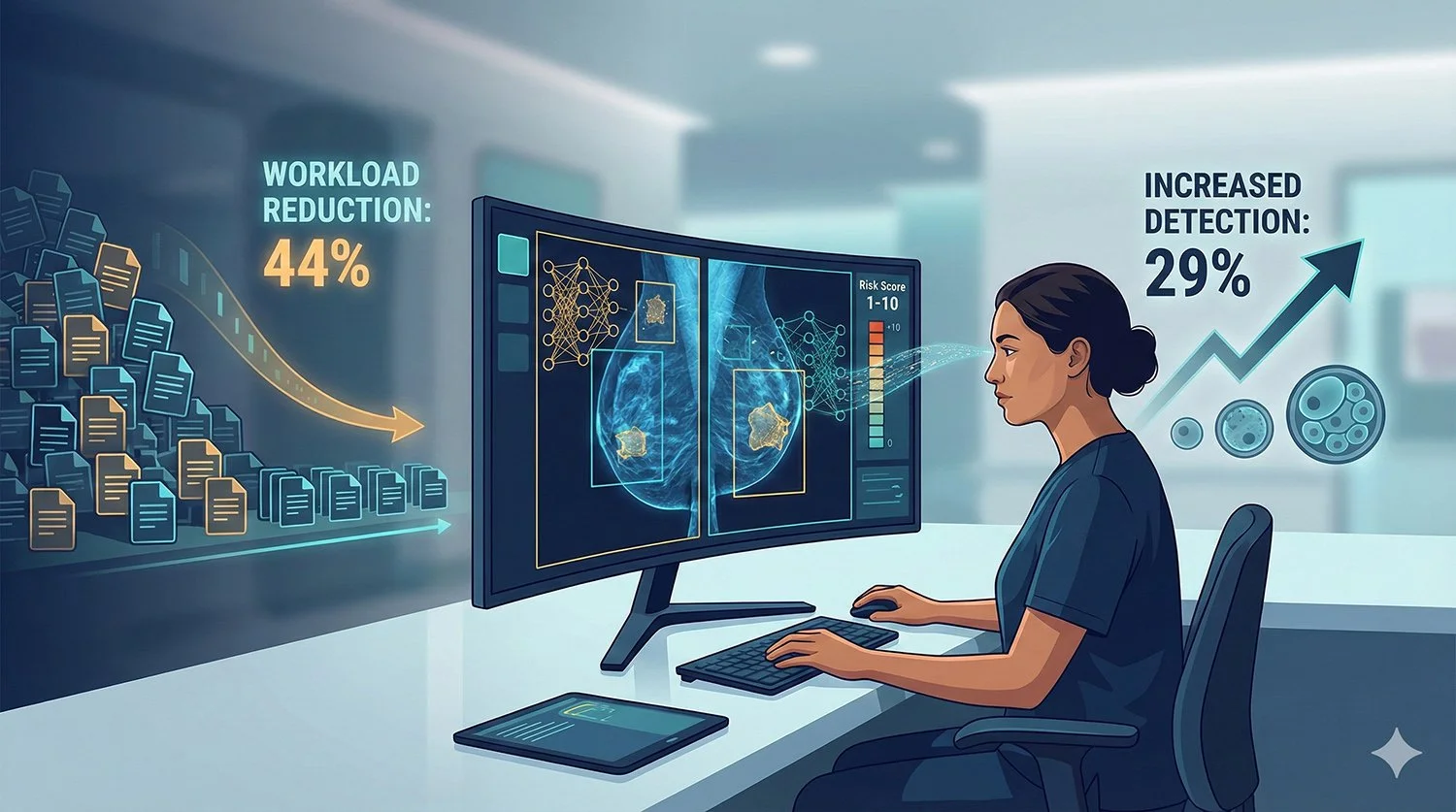
AI-generated Image (Credit: Jacky Lee)
Artificial intelligence software used alongside radiologists increased breast cancer detection and substantially reduced reading workload in a large Swedish randomised screening study, adding fresh evidence that AI may be able to strengthen routine mammography without increasing false positives.
The results come from a protocol-defined analysis of the Mammography Screening with Artificial Intelligence (MASAI) trial, published online February 3, 2025 in The Lancet Digital Health. The study was conducted within Sweden’s national screening programme across four sites in southwest Sweden: Malmö, Lund, Landskrona, and Trelleborg.


























Trial Design
Between April 12, 2021 and Dec 7, 2022, the MASAI team randomly assigned 105,934 women to either AI-supported screening or standard double reading. Nineteen women were excluded from the analysis.
The AI arm used Transpara version 1.7.0 (ScreenPoint Medical, Netherlands) to triage exams and support detection. The system provides an examination-based malignancy risk score on a 10-point scale. In the MASAI workflow, scores 1–9 were routed to single reading, while score 10 triggered double reading, with AI marks available for higher-risk cases.




















Key Findings
AI-supported screening among 53,043 participants detected 338 cancers and led to 1,110 recalls. Standard screening among 52,872 participants detected 262 cancers and led to 1,027 recalls. This translated to cancer detection rates of 6.4 per 1,000 screens in the AI group versus 5.0 per 1,000 in the control group — a 29% relative increase.
The additional cancers detected with AI support were largely clinically meaningful early findings. The AI group showed increased detection of invasive cancers, particularly small, lymph-node negative tumours, and also a higher detection of in situ cancers, with the increase skewing toward higher-grade in situ disease rather than low-grade lesions.
Importantly, recall and false-positive rates were not significantly higher in the AI group, while the positive predictive value of recall was higher.
Workload effects were substantial. The study reported 61,248 screen readings in the AI group versus 109,692 in the control group — a 44.2% reduction in reading workload.


















How These Results Extend Earlier MASAI Evidence
An earlier pre-specified safety analysis published in 2023 in The Lancet Oncology found AI-supported screening achieved a similar cancer detection rate to standard double reading while cutting workload by roughly 44%. The trial therefore continued to its planned interval cancer endpoint.
The 2025 analysis builds on that foundation by showing a clearer improvement in detection alongside the same scale of workload reduction, without a significant rise in false positives.













Funding and Competing Interests
The 2025 Lancet Digital Health analysis lists funding from the Swedish Cancer Society, the Confederation of Regional Cancer Centres, and Swedish governmental clinical research funding. The abstract also notes that Kristina Lång has served on an advisory board for Siemens Healthineers and received a lecture honorarium from AstraZeneca; other authors declared no competing interests.

















Company and Regulatory Context
ScreenPoint Medical was incorporated in 2014 as a Radboud University Medical Center spin-off focused on AI for breast imaging.
Transpara has continued to evolve beyond the version used in MASAI. A newer FDA-cleared update (Transpara 2.1.0) includes temporal comparison capabilities and broader manufacturer compatibility, according to FDA documentation.



















What This Could Mean for Screening Programmes
Breast cancer screening aims to reduce mortality by detecting cancers earlier, when treatment is typically less extensive and outcomes are better. Large evidence reviews cited in Australia’s BreastScreen reporting indicate that women aged 50–69 who attend mammography screening have about a 40% lower risk of dying from breast cancer, with benefits also observed in ages 70–74.
In Australia, breast cancer remains the most commonly diagnosed cancer in women, with around 20,000 female cases projected in 2025 and about 3,300 female deaths estimated nationally. Five-year survival has risen to about 93% in recent cohorts. The disease is the second most common cause of cancer-related death in Australian women, behind lung cancer.
Against that backdrop, the MASAI results suggest AI-supported reading could help programmes maintain or improve performance while easing workforce pressure — an issue many health systems face — even though longer-term endpoints like interval cancer rates and cost-effectiveness remain crucial for policy decisions.














Next Evidence to Watch
A large US-based randomised controlled trial known as PRISM will test Transpara in real-world clinical workflows at scale, supported by a USD 16 million national study led by UCLA and UC Davis. The trial will examine whether AI support can improve early detection and reduce unnecessary callbacks while also assessing clinician and patient experience.






















Source: NLM, Radboud umc, FDA, AIHW, UCLA Health














 TheDayAfterAI News
We are a leading AI-focused digital news platform, combining AI-generated reporting with human editorial oversight. By aggregating and synthesizing the latest developments in AI — spanning innovation, technology, ethics, policy and business — we deliver timely, accurate and thought-provoking content.