
AI Showdown: 6 Leading Chatbots Predict TEM Stock Price
Disclaimer: This article is for informational and educational purposes only. The predictions and analyses presented herein were generated by AI systems and should not be construed as financial advice, investment recommendations, or solicitations to buy or sell any securities. Stock prices are inherently unpredictable, and all investments carry risk of loss. Past performance does not guarantee future results. Readers should consult qualified financial advisors before making any investment decisions. TheDayAfterAI News and its contributors do not accept liability for any losses arising from reliance on this content.
In an unprecedented experiment, TheDayAfterAI News tasked six of the world's most advanced AI chatbots with the same challenge: predict the stock price movement for Tempus AI, Inc. (NASDAQ: TEM) over a 5-trading-day period from January 12-16, 2026. Each AI was given identical access to market data, technical indicators, and fundamental catalysts, yet their conclusions varied significantly.
This analysis arrives at a pivotal moment for TEM, which announced preliminary Q4/FY2025 results on January 11, 2026, revealing 83% year-over-year revenue growth to approximately $1.27 billion. The stock surged in pre-market trading, setting the stage for a volatile week with CPI data on Tuesday and monthly options expiration on Friday.
We deployed ChatGPT, Gemini, Perplexity, Grok, Claude, and Microsoft Copilot to analyze identical market conditions. Here is what they predicted.
















Prediction Summary at a Glance
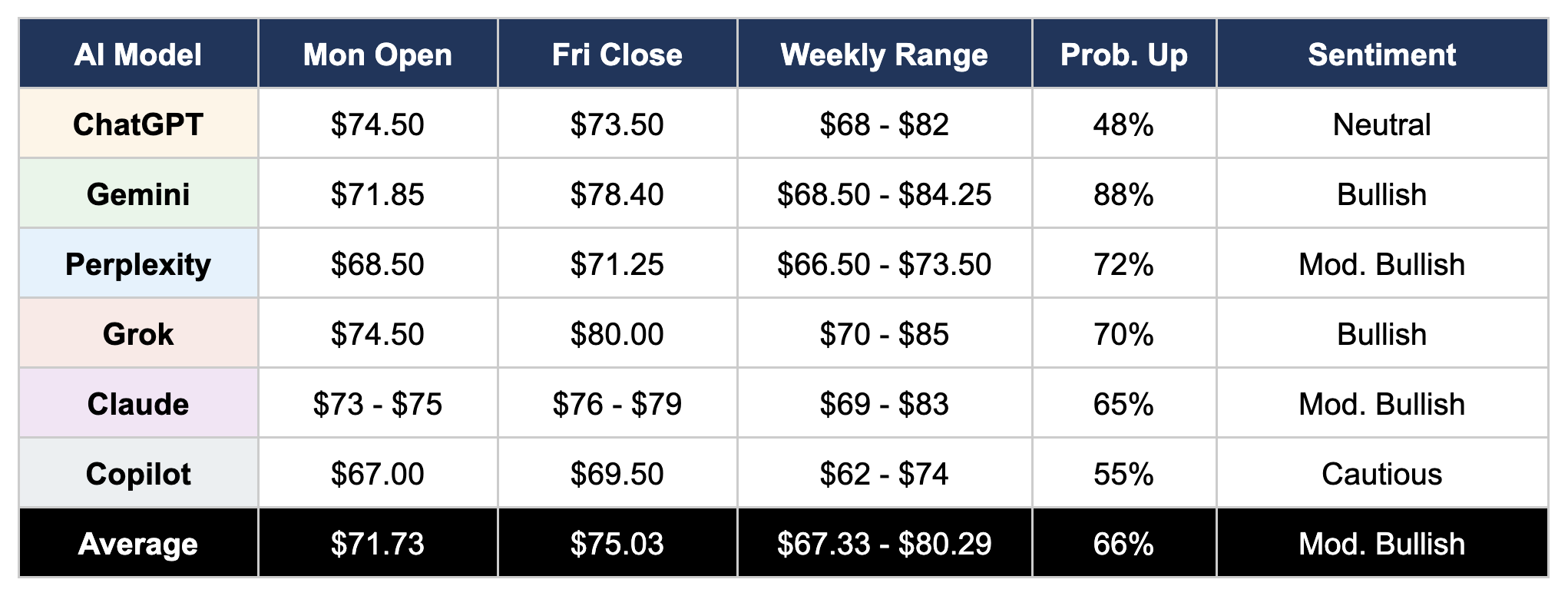
The table below consolidates the key predictions from all six AI models for TEM during the trading week of January 12-16, 2026.
























Individual AI Analysis
ChatGPT: The Cautious Realist
ChatGPT delivered the most conservative outlook among the six models, assigning only a 48% probability of weekly gains. Its analysis emphasized the historical tendency for gap-ups to retrace, particularly when combined with macroeconomic catalysts like Tuesday's CPI release and Friday's options expiration.
The model projected a Monday open at $74.50 following the pre-market surge but anticipated profit-taking would drag the Friday close to $73.50. ChatGPT's day-by-day forecast showed a volatile trajectory: an initial Monday fade, a CPI-driven Tuesday bounce, mid-week consolidation, and OPEX pinning effects pulling the price down into the close.
Key insight: "Gap-ups frequently retrace and CPI + OPEX raises the odds of a late-week fade/pin."
Gemini: The Aggressive Bull
Gemini emerged as the most bullish forecaster, assigning an 88% probability of weekly gains. The model framed the preliminary results as a "paradigm shift" and "definitive inflection point," arguing that the transition to positive adjusted EBITDA fundamentally alters the investment thesis.
Gemini's analysis incorporated sophisticated derivatives analysis, noting that with 16.17% short interest and a days-to-cover ratio of 4.65, the conditions were ripe for a short squeeze. The model projected a Friday close of $78.40, representing meaningful upside from the Monday open of $71.85.
Key insight: "The achievement of profitability typically unlocks a new tier of institutional capital—endowments and pension funds that are restricted from owning unprofitable companies."
Perplexity: The Measured Optimist
Perplexity took a notably different approach, projecting a lower Monday open of $68.50, suggesting the pre-market surge might partially fade before the regular session. Despite this more conservative opening estimate, the model maintained a 72% probability of weekly gains with a Friday close target of $71.25.
The analysis emphasized the supportive macro backdrop, including low VIX levels (15.45), positive market breadth with 54%+ of S&P 500 constituents trading above their 200-day moving averages, and strong healthcare sector leadership. Perplexity's narrower predicted range of $66.50-$73.50 reflected a more tempered volatility expectation.
Key insight: "Weekly options expiration on January 16 creates predictable algorithmic support around the $70-72 level."
Grok: The Technical Optimist
Grok aligned closely with ChatGPT on the opening price ($74.50) but diverged significantly on the trajectory, projecting a Friday close of $80.00 with 70% probability of gains. The model emphasized favorable technical conditions: neutral RSI around 53-54, improving MACD despite recent bearishness, and a potential golden cross setup.
Grok's analysis incorporated sentiment data showing 342 institutional investors had recently added positions, and ARK Invest's involvement provided a supportive narrative. The model identified the declining short interest (from 16.92% in November to 10.47%) as reducing downward pressure while maintaining squeeze potential.
Key insight: "Low VIX (14.49) and bullish put/call ratios indicate favorable market conditions, but upcoming CPI data and options expiration may add volatility."
Claude: The Balanced Analyst
Claude delivered a measured bullish forecast with 65% probability of weekly gains, emphasizing both the exceptional fundamental catalyst and the inherent risks. The model projected a Monday open of $73-75 with a Friday close of $76-79, representing moderate upside as "much of the positive news is priced into the pre-market gap."
The analysis provided detailed scenario probabilities: 25% bull case ($80-85 close), 40% base case ($74-79 close), and 35% bear case ($68-73 close). Claude highlighted the stock's high beta (2.19) and 5.64% average daily range as factors requiring appropriate position sizing, while noting the fundamental support from preliminary results should limit downside.
Key insight: "The base case projection targets a Friday close of $76-79, representing modest gains from Monday's opening as much of the positive news is priced into the pre-market gap."
Microsoft Copilot: The Conservative Skeptic
Copilot presented the most conservative forecast, with predictions notably below other models. The AI projected a Monday open of $67.00—significantly below the pre-market indications—and a Friday close of $69.50, representing only a 55% probability of weekly gains.
The model's narrow estimated range of $62-$74 suggested skepticism about sustained momentum. Copilot emphasized macroeconomic risks, particularly the potential for hot CPI prints to pressure growth stocks, and maintained that technicals showed only a "mild bullish bias" from the recent pullback into the $60s.
Key insight: "If CPI prints significantly above consensus, sharp selloff into $62 or lower; weekly close $60-$64."


























Common Themes and Divergences
Points of consensus: All six models agreed on several fundamental points. The preliminary Q4/FY2025 results represented a significant positive catalyst. Tuesday's CPI release posed the primary macro risk to bullish scenarios. Options expiration Friday would likely introduce volatility and potential pinning effects. Short interest levels created conditions favorable for squeeze dynamics.
Key divergences: The models diverged most significantly on three dimensions. Opening price estimates ranged from $67.00 (Copilot) to $74.50 (ChatGPT, Grok), a spread of $7.50 or approximately 11%. Probability assessments varied from 48% (ChatGPT) to 88% (Gemini), reflecting vastly different interpretations of identical data. Volatility expectations showed Gemini projecting a $15.75 weekly range while Perplexity anticipated only $7.00.




















Conclusion
This experiment reveals both the promise and limitations of AI-driven market analysis. While all models processed similar data, their conclusions varied significantly—a reminder that even sophisticated AI systems apply different interpretive frameworks that lead to divergent predictions.
The consensus view leans bullish, with five of six models assigning greater than 50% probability to weekly gains. The average predicted Friday close of $74.78 represents a 4.5% gain from the average predicted Monday open. However, the wide dispersion in forecasts—from Copilot's cautious $69.50 to Grok's optimistic $80.00—underscores the uncertainty inherent in short-term market predictions.
We will revisit these predictions after market close on Friday, January 16, 2026, to evaluate each model's accuracy. Stay tuned for our follow-up analysis comparing AI predictions against actual market outcomes.
For the complete breakdown — including day-by-day price targets, specific option strikes to watch, and detailed institutional flow analysis — please refer to the Full Report.
License This Article









 TheDayAfterAI News
We are a leading AI-focused digital news platform, combining AI-generated reporting with human editorial oversight. By aggregating and synthesizing the latest developments in AI — spanning innovation, technology, ethics, policy and business — we deliver timely, accurate and thought-provoking content.