
6 Leading Chatbots Predict Google (GOOG) Stock Performance

Disclaimer: This article is for informational and educational purposes only. The predictions and analyses presented herein were generated by AI systems and should not be construed as financial advice, investment recommendations, or solicitations to buy or sell any securities. Stock prices are inherently unpredictable, and all investments carry risk of loss. Past performance does not guarantee future results. Readers should consult qualified financial advisors before making any investment decisions. TheDayAfterAI News and its contributors do not accept liability for any losses arising from reliance on this content.
In an unprecedented comparative study, TheDayAfterAI News tasked six of the world's leading AI chatbots with analysing Alphabet Inc. Class C (NASDAQ: GOOG) stock and predicting its performance over the upcoming five trading days. This experiment aims to evaluate how different AI systems interpret market data, technical indicators, and macroeconomic factors when making short-term price forecasts.
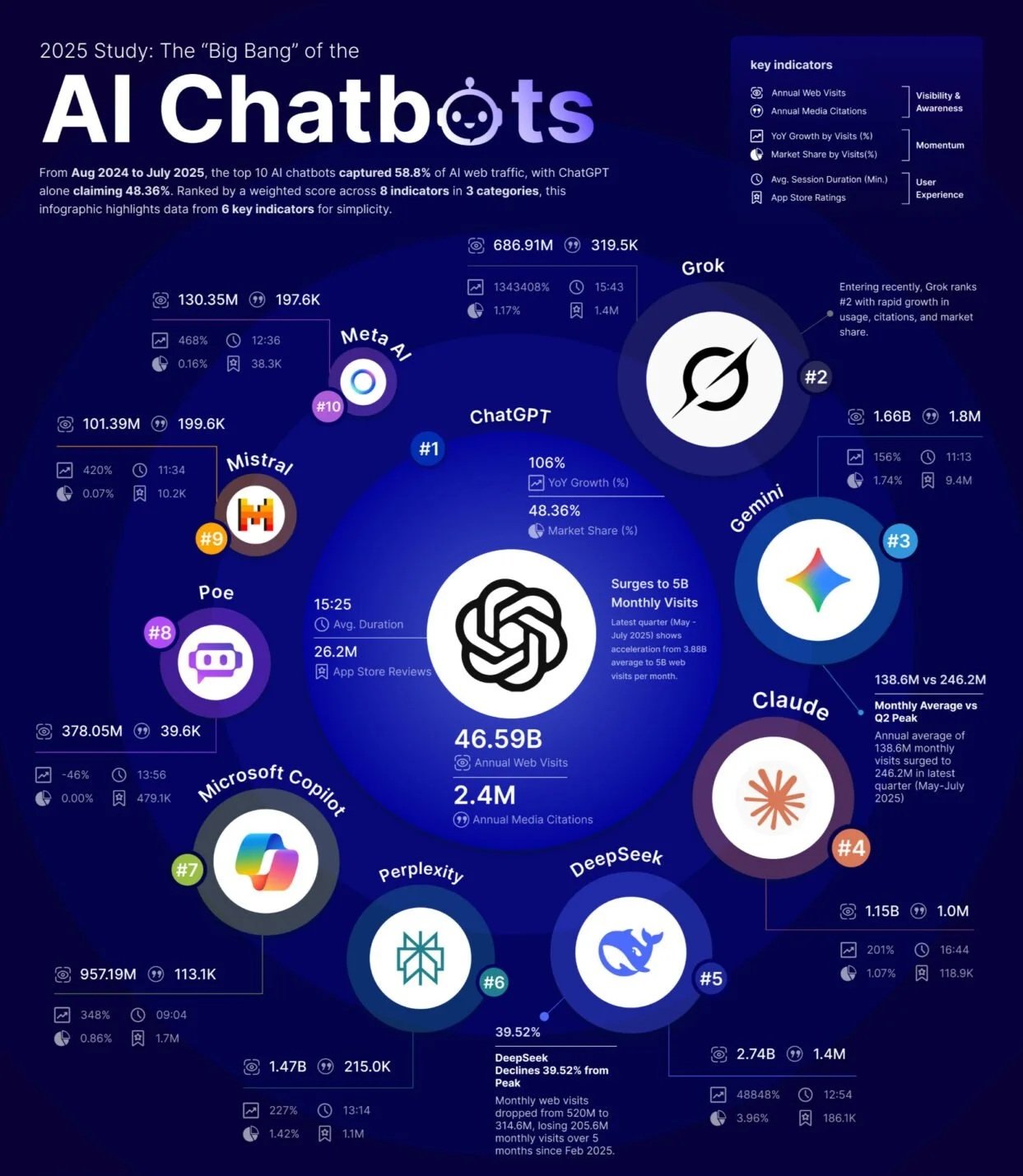
The participating AI systems — Claude (Anthropic), ChatGPT (OpenAI), Gemini (Google), Perplexity, Grok (xAI), and Copilot (Microsoft) — were each given identical prompts requesting comprehensive analysis of GOOG's price action, technical indicators, market sentiment, and fundamental catalysts for the period from December 26, 2025 to January 2, 2026.
Key Finding: All six AI systems reached a consensus bullish outlook, with probability estimates for price increases ranging from 55% to 65%. This remarkable alignment suggests that current market conditions present a compelling case for near-term appreciation, though the magnitude and confidence levels vary notably across platforms.













Trading Period Context
The forecast period spans a unique trading environment characterised by holiday-induced liquidity constraints and year-end portfolio adjustments. The five trading days are:
December 26 (Friday): Post-Christmas trading, historically positive
December 29 (Monday): Light volume expected
December 30 (Tuesday): FOMC Minutes release (potential volatility catalyst)
December 31 (Wednesday): Year-end window dressing, early close
January 1 (Thursday): MARKET CLOSED (New Year's Day)
January 2 (Friday): First trading day of 2026, ISM Manufacturing PMI release




















Comparative Results: AI Chatbot Predictions
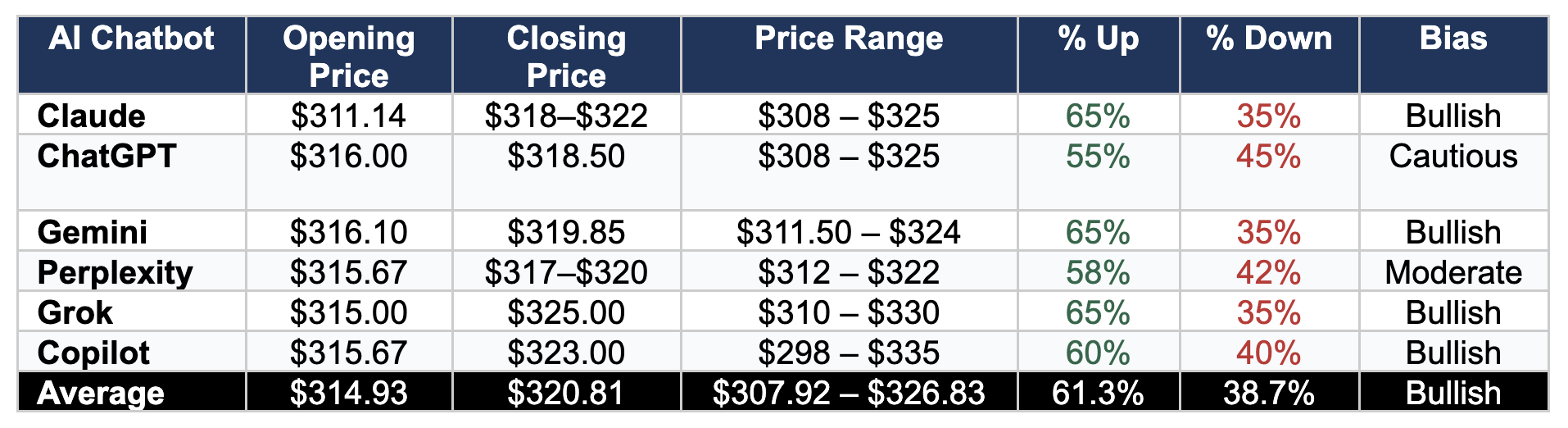
The following table presents the key predictions from each AI system, enabling direct comparison of their forecasts:






















Claude (Anthropic)
Confidence Level: 65% bullish | Target Close: $318–$322
Claude's analysis emphasised the "Santa Claus Rally" effect, noting that December 26 is historically the most consistently positive trading day of the year for the S&P 500. The model highlighted bullish options flow with a put/call ratio of 0.79, strong analyst consensus (43 analysts with "Strong Buy" ratings), and Gemini's market share surge from 5% to 18.2% in generative AI traffic as key supporting factors. Claude flagged antitrust remedies and thin holiday volumes (~73% below average) as primary risks.

















ChatGPT (OpenAI)
Confidence Level: 55% bullish | Target Close: $318.50
ChatGPT presented the most conservative outlook among the six systems. The analysis noted an RSI of approximately 70.06, indicating "overbought-ish" conditions that could trigger mean-reversion. ChatGPT provided detailed day-by-day forecasts, identifying December 30 (FOMC Minutes) and January 2 (ISM PMI) as key volatility triggers. The model assigned a 90% confidence range of $305–$328, reflecting awareness of tail risk scenarios.


























Gemini (Google)
Confidence Level: 65% bullish | Target Close: $319.85
Gemini produced the most comprehensive analysis, spanning 15 pages with detailed scenario breakdowns. The model emphasised the "convergence" thesis—valuation dislocation, AI infrastructure pivot, and systematic flows creating a structural bid for quality assets. Gemini notably incorporated options market microstructure analysis, including Max Pain levels ($302.50–$305.00) and gamma exposure dynamics. The analysis provided granular daily forecasts with specific price ranges for each session.




















Perplexity
Confidence Level: 58% bullish | Target Close: $317–$320
Perplexity's analysis was characterised by extensive citation of primary sources, with 39 references supporting its conclusions. The model highlighted a stochastic reading of 89.2 (overbought) as a key concern, suggesting 35–40% pullback probability. Perplexity uniquely noted that the S&P 500's cumulative advance-decline ratio reaching all-time highs represents "a significant bullish divergence" supporting the broader market. The analysis assigned a 70% probability to range-bound trading ($314–$320).
















Grok (xAI)
Confidence Level: 65% bullish | Target Close: $325.00
Grok produced the most bullish closing price target at $325, representing approximately 3.2% upside from the opening estimate. The model emphasised positive catalysts including the recent Intersect acquisition ($4.75B for data centres and clean energy), analyst upgrades to the $350–$400 range, and tech sector outperformance (+60% YTD for Alphabet). Grok noted that thin holiday volumes could amplify moves, but weighted bullish sentiment and technical factors as dominant.




















Copilot (Microsoft)
Confidence Level: 60% bullish | Target Close: $323.00
Copilot provided the widest price range ($298–$335), reflecting acknowledgment of extreme tail scenarios in low-liquidity conditions. The analysis emphasised heavy call skew in unusual options activity as a primary bullish indicator. Copilot uniquely offered actionable trading notes, recommending tighter stops due to thin liquidity and monitoring of intraday options flow for directional conviction.














Key Findings and Observations
Areas of Consensus
Bullish Directional Bias: All six AI systems predicted a greater than 50% probability of price increase, with the range spanning 55% (ChatGPT) to 65% (Claude, Gemini, Grok).
Holiday Liquidity Concerns: Every model explicitly addressed reduced trading volume as a key risk factor, noting potential for amplified volatility in either direction.
Support Level Agreement: All systems identified the $307–$313 zone as critical support, coinciding with the 50-day and 200-day moving average confluence.
Seasonality Recognition: The "Santa Claus Rally" phenomenon was cited by all six models as a historically positive factor for the forecast period.
FOMC Minutes Catalyst: December 30 was uniformly identified as the primary volatility event, with potential for hawkish surprises to cap upside.
Areas of Divergence
Price Range Width: Copilot's range ($298 to $335 = $37 spread) was nearly four times wider than Perplexity's ($312 to $322 = $10 spread), reflecting different approaches to uncertainty quantification.
Technical vs. Fundamental Weighting: ChatGPT and Perplexity emphasised technical indicators (RSI, stochastics), while Gemini and Claude weighted fundamental factors (AI infrastructure, analyst targets) more heavily.
Opening Price Estimates: Claude's $311.14 opening estimate diverged significantly from more than $315 cited by the other 5 chatbots, reflecting different baseline assumptions.
Analysis Depth: Gemini's 15-page report with 25 citations contrasted sharply with Copilot's 2-page summary, demonstrating significant variation in analytical thoroughness.















Conclusion
The remarkable consensus among six independently developed AI systems suggests that current market conditions — characterised by supportive seasonality, bullish options positioning, and accommodative monetary policy — create a favourable environment for GOOG in the near term. However, the variation in confidence levels (55–65%) and price targets ($317–$325 close) reminds us that even sophisticated AI systems approach uncertainty differently.
TheDayAfterAI News will publish a follow-up article after January 2, 2026, comparing actual market outcomes against each AI system's predictions. This will provide valuable insights into the relative accuracy and calibration of leading AI chatbots for financial analysis tasks.
Stay tuned for our post-period analysis and accuracy report.










License This Article
 TheDayAfterAI News
We are a leading AI-focused digital news platform, combining AI-generated reporting with human editorial oversight. By aggregating and synthesizing the latest developments in AI — spanning innovation, technology, ethics, policy and business — we deliver timely, accurate and thought-provoking content.