
Bamboo or Nets? We Asked AI to Settle the Hong Kong Fire Debate with Science
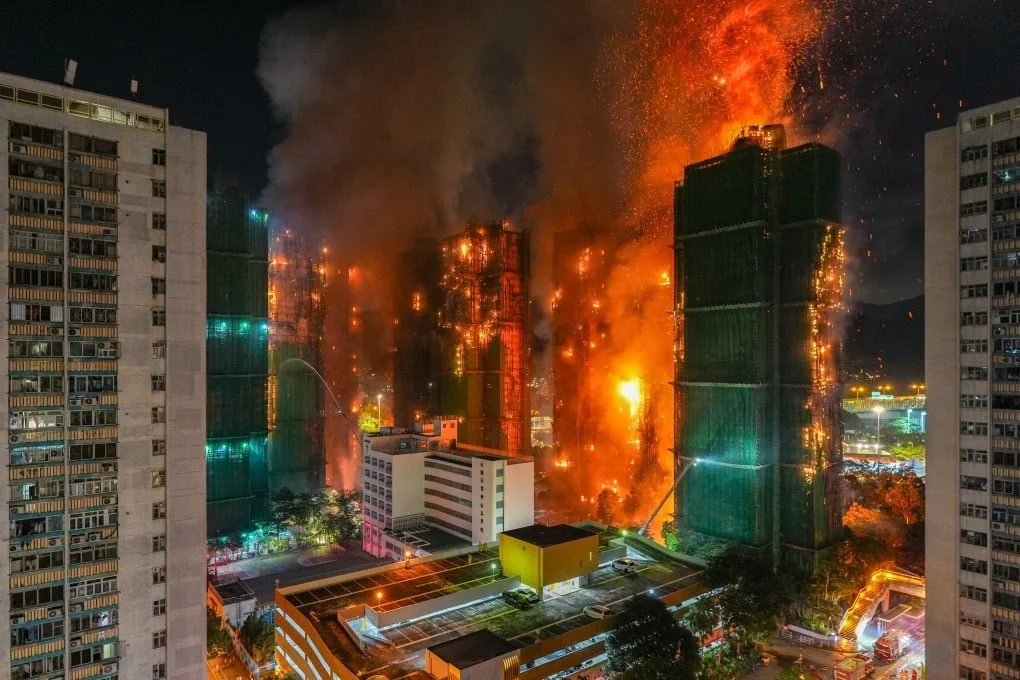
Image Source: SCMP (Credit: Eugene Lee)
In the days since the Wang Fuk Court inferno claimed at least 128 lives, a fierce debate has erupted across Hong Kong and beyond: was it the traditional bamboo scaffolding or the "cheap Chinese nets" that turned a fire into a catastrophe? Social media is divided, headlines are pointing fingers, and the public wants answers.
At TheDayAfterAI, we decided to cut through the noise. Rather than amplify speculation, we turned to Claude — Anthropic's advanced AI assistant — and asked it to analyse the disaster using fire science principles. What we received was a detailed, methodical breakdown that suggests the "bamboo vs nets" framing may be missing the point entirely.



























The Public Debate: A City Divided
Since the fire swept across seven of the estate's eight high-rise towers on 26 November, public discourse has crystallised into two camps. Some blame Hong Kong's iconic bamboo scaffolding — a centuries-old construction tradition that remains ubiquitous across the city. Others point to the green plastic safety nets and polystyrene foam boards wrapped around the scaffolding, with particular ire directed at materials allegedly sourced from mainland China.
But which is it? We posed this question directly to Claude, providing it with the available evidence and asking for a fire science analysis.






























Claude's Verdict: It's Not Either/Or
Claude's analysis was unequivocal: framing this as a binary choice between bamboo and nets fundamentally mischaracterises the disaster.
"To understand what happened, we need to consider three elements of fire spread: ignition, flame propagation, and sustained burning. Each of these phases was dominated by different materials."
According to Claude's breakdown, the plastic mesh and foam coverings acted as what fire scientists call the "fuse and chimney", while the bamboo scaffolding served as the "fuel load". Neither alone would have produced the scale of devastation witnessed at Wang Fuk Court.
























The Plastic Encapsulation: Accelerant and Chimney
Claude identified the plastic safety nets, typically woven from polyethylene, polypropylene, or nylon, as the more critical factor in explaining the speed and pattern of the fire's spread.
"Thermoplastics ignite at relatively low temperatures, around 300-400°C for PE/PP, compared to bamboo. They don't need sustained heat to catch fire. And once alight, they exhibit characteristic behaviours that accelerate façade fires dramatically."
The key mechanism, Claude explained, is something fire engineers call the chimney effect. When scaffolding is fully enclosed, with mesh on the outside, foam boards blocking windows, and bamboo framing in between, a narrow vertical cavity is created. Hot gases rise, pre-heating materials above, while the draft accelerates flame spread. Research on façade fires shows flame spread rates in such cavities can be three to five times faster than on open surfaces.
Claude also highlighted the phenomenon of burning droplets: molten plastic raining down, creating secondary ignition points below and spreading fire laterally. The witness videos from Tai Po showing "dripping flaming plastic" are, according to Claude, "textbook thermoplastic failure".






















The Bamboo: Fuel, Not Ignition Source
So does this exonerate bamboo? Not quite, but Claude's analysis suggests its role was fundamentally different.
"Bamboo clearly burns, but it usually needs strong, sustained heat to ignite fully. With a charring rate of approximately 1mm per minute, similar to timber, the thick poles take time to catch fire. Bamboo is unlikely to have been the initial trigger for such a fast-moving fire."
However, once the fire was established by the plastic encapsulation, the bamboo scaffolding across seven towers represented an enormous quantity of combustible material. This sustained the fire long after the plastic would have been consumed, and the eventual scaffold collapse spread embers and burning material across the development.
"The bamboo amplified the consequences but didn't cause the disaster. If the same scaffolding had been wrapped in genuinely fire-retardant materials — or left open — the outcome would likely have been dramatically different."




















The Real Failure: Regulation Without Enforcement
Perhaps the most damning part of Claude's analysis concerned the regulatory framework, or rather, its apparent failure.
Hong Kong's Labour Department already requires protective nets on scaffolding to have "appropriate fire-retardant properties" meeting recognised standards such as NFPA 701 or BS 5867-2 Type B. If those standards had been enforced, Claude noted, the nets should have self-extinguished rather than propagating flames.
"The gap between 'deemed compliant on paper' and actual performance is where this tragedy was born. Residents at Wang Fuk Court had reportedly warned authorities about the flammability of the mesh and coverings for over a year before the fire."
This enforcement gap is now central to the criminal investigation, with multiple arrests made on suspicion of gross negligence and manslaughter.




























A Systems Failure
Claude's conclusion challenges the simplistic narratives dominating public discourse:
"Treating this as a choice between 'ban bamboo' or 'blame the net' risks missing the systemic issues: procurement of non-compliant materials, weak site supervision, poor housekeeping, and inadequate enforcement of existing fire-retardant rules. It was not just the age-old bamboo poles that failed — it was the modern layers of mesh, foam, and oversight wrapped around them."
For a city now grappling with its deadliest fire since 1948, the lesson may be uncomfortable: the problem isn't choosing between tradition and modernity, but ensuring that whichever materials are used, the rules meant to keep people safe are actually followed.


























Source: TheDayAfterAI News, Claude’s Analysis

















 TheDayAfterAI News
We are a leading AI-focused digital news platform, combining AI-generated reporting with human editorial oversight. By aggregating and synthesizing the latest developments in AI — spanning innovation, technology, ethics, policy and business — we deliver timely, accurate and thought-provoking content.