
AI Service Radio Content Pro Brings Automated Content Creation to Broadcasters

Image Source: Radio Content Pro
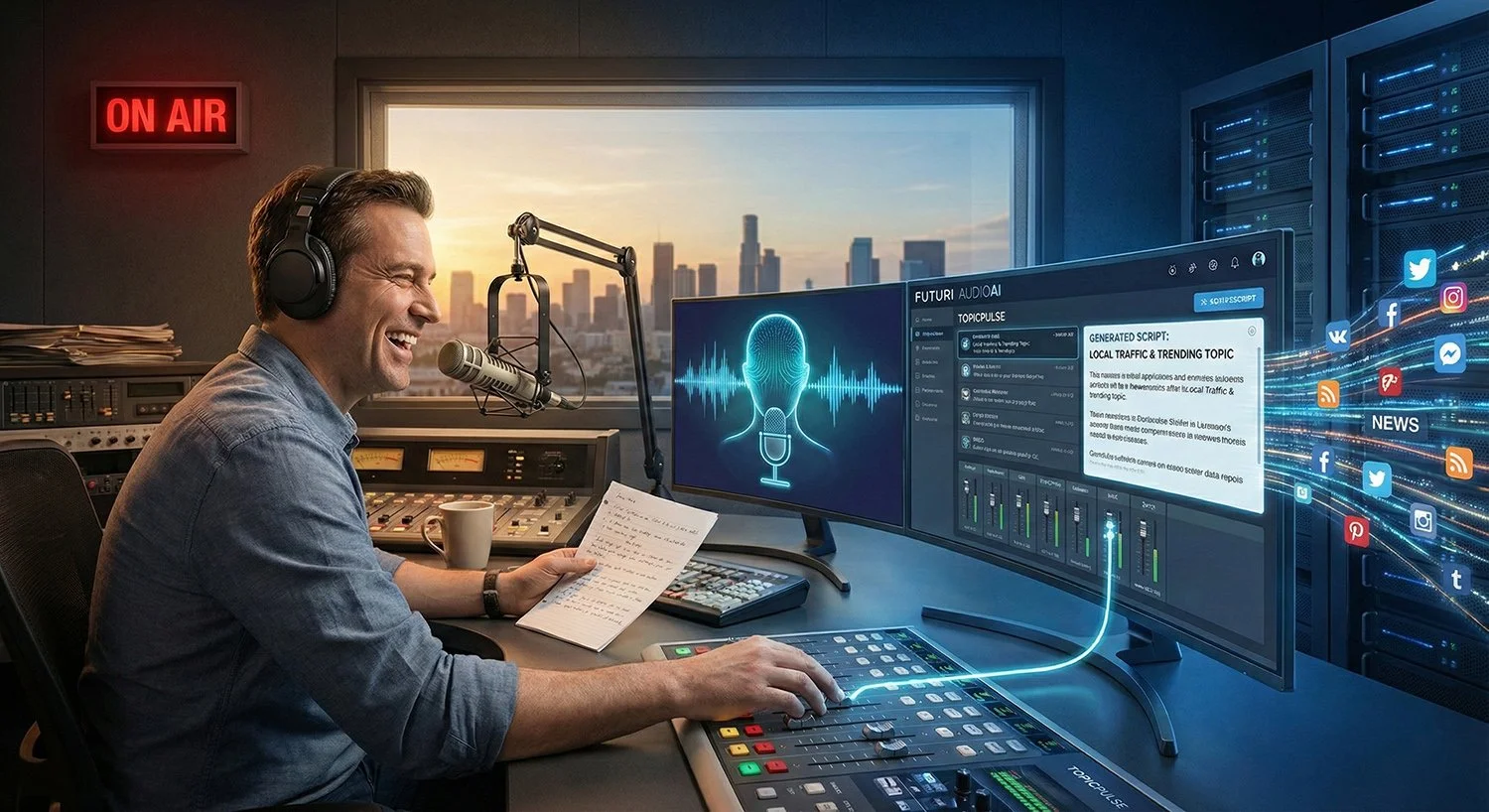
Radio Content Pro, an artificial intelligence-driven platform developed by Tracy Johnson Media Group in partnership with WP Media, provides radio stations with continuously updated, curated content tailored to specific formats and markets, marking a step in the integration of AI tools into broadcasting operations.
The service, which debuted on February 6, 2024, uses AI algorithms to gather, organize and rewrite content from various sources, including news, entertainment and local events, for use across on-air, digital and social media platforms. It addresses challenges faced by radio stations, such as time constraints in content preparation and the need for hyper-local relevance, by automating routine tasks while allowing human oversight for final output.

























Service Features and Operations
Radio Content Pro operates through a dashboard accessible 24/7, offering format-specific content kits for genres including Top 40, Rock, Country, Hip Hop, Adult Contemporary, Christian and Hispanic music. Each kit is market-exclusive, ensuring stations in the same area receive unique material to avoid duplication.
Central to the platform is Ava Hart, an AI copilot trained on radio-specific data, which personalizes content by rewriting it to match a station's brand voice, tone and audience preferences. For instance, it can generate teases, blog posts, social media updates and phone topic ideas from raw stories.
The service expanded on April 17, 2025, with Local Pulse (now branded Local Beat), an AI module that scans local websites, news outlets and event listings in designated markets to produce content in 13 formats, such as on-air scripts, videos and news copy. This addition coincided with new offerings for R&B and Rhythmic Adult Contemporary formats, incorporating current, nostalgic and lifestyle topics developed in collaboration with industry programmers.
Separately, RCP INFO, launched for News and Talk stations, processes breaking news, pop culture and viral stories into real-time alerts, concise rundowns and ready-to-air analysis, representing an expansion in the lineup. Availability includes market-exclusive barter for qualifying stations based on audience metrics.
Tracy Johnson, president and CEO of Tracy Johnson Media Group, which partners with WP Media on development, described the tools as outcomes of extended testing to meet broadcasting standards. The company, based in the United States, has also extended the service to Canada through Orbyt Media.






























Background of AI Adoption in Radio
Artificial intelligence in radio broadcasting traces back to the 1980s with basic automation for music scheduling and traffic reports, but significant advancements emerged in the 2010s through machine learning for audience analytics and voice recognition. The rise of generative AI, fuelled by models like those behind ChatGPT since 2022, shifted focus to content creation, enabling tools to summarize news or generate scripts.
This evolution responded to industry pressures, including declining ad revenues from digital competition and workforce reductions post-COVID-19, which heightened the need for efficient content production without expanding staff. In Europe and Asia, early experiments included AI-hosted shows in Switzerland and Indonesia, where stations like Radio Mustang in Jakarta used AI for segments with an AI broadcaster named Aimee.
Radio Content Pro's launch aligns with this timeline, building on prior AI prep services while emphasizing radio-trained algorithms to curate rather than fully automate broadcasts.

















Development and Industry Context
The platform's development involved over a year of refinement for specialized formats, incorporating feedback from programmers to ensure cultural and demographic relevance, such as in the Urban AC expansion. Partnerships, including with the Radio Vendor Alliance, facilitated broader adoption by integrating it into vendor ecosystems for stations.
Broader industry development shows AI tools like Sidekick AI, which converts music charts into blog posts, emerging concurrently to complement human talent. In Europe, guidelines emphasize ethical use to preserve journalistic integrity, as seen in EU-wide initiatives addressing AI in media.
These advancements stem from the need to compete with streaming services like Spotify, which use AI for personalized playlists, pushing traditional radio toward hybrid models.



















Impact on the Radio Sector
AI integration via services like Radio Content Pro enhances operational efficiency, allowing stations to produce more content with fewer resources, potentially improving listener engagement through timely, localized material. For example, it reduces preparation time from hours to minutes, enabling personalities to focus on delivery.
However, it raises concerns about job displacement, with studies identifying roles in sales, content curation and even on-air talent as vulnerable, as AI could automate routine tasks in marketing and production. Listener surveys indicate mixed reception: 21% report exposure to AI-powered stations, but many prefer human elements for authenticity.
Economically, AI aids revenue through targeted ads and analytics, but analysts suggest it may exacerbate inequalities between large networks and independent stations lacking resources for implementation.




























Future Trends in AI for Radio
Projections from industry reports suggest AI will deepen personalization, with algorithms predicting listener preferences for dynamic programming and ads by 2029. Trends include fully automated stations for niche markets and AI-enhanced remote programming, integrating with IoT devices for voice-activated interactions.
Ethical guidelines will likely emerge to balance automation with human oversight, addressing biases in content generation and ensuring transparency in AI use. Global markets may see accelerated adoption in Asia and Africa for cost-effective broadcasting, while regulations could mandate disclosure of AI-generated content.
Overall, while tools like Radio Content Pro represent current efficiencies, the sector's trajectory points to a hybrid future where AI augments rather than replaces human creativity.
















Source: Google Blog, Wellcome














 TheDayAfterAI News
We are a leading AI-focused digital news platform, combining AI-generated reporting with human editorial oversight. By aggregating and synthesizing the latest developments in AI — spanning innovation, technology, ethics, policy and business — we deliver timely, accurate and thought-provoking content.