
UQ Trials Wearable Robotic Exoskeleton to Assist Walking for People with MND
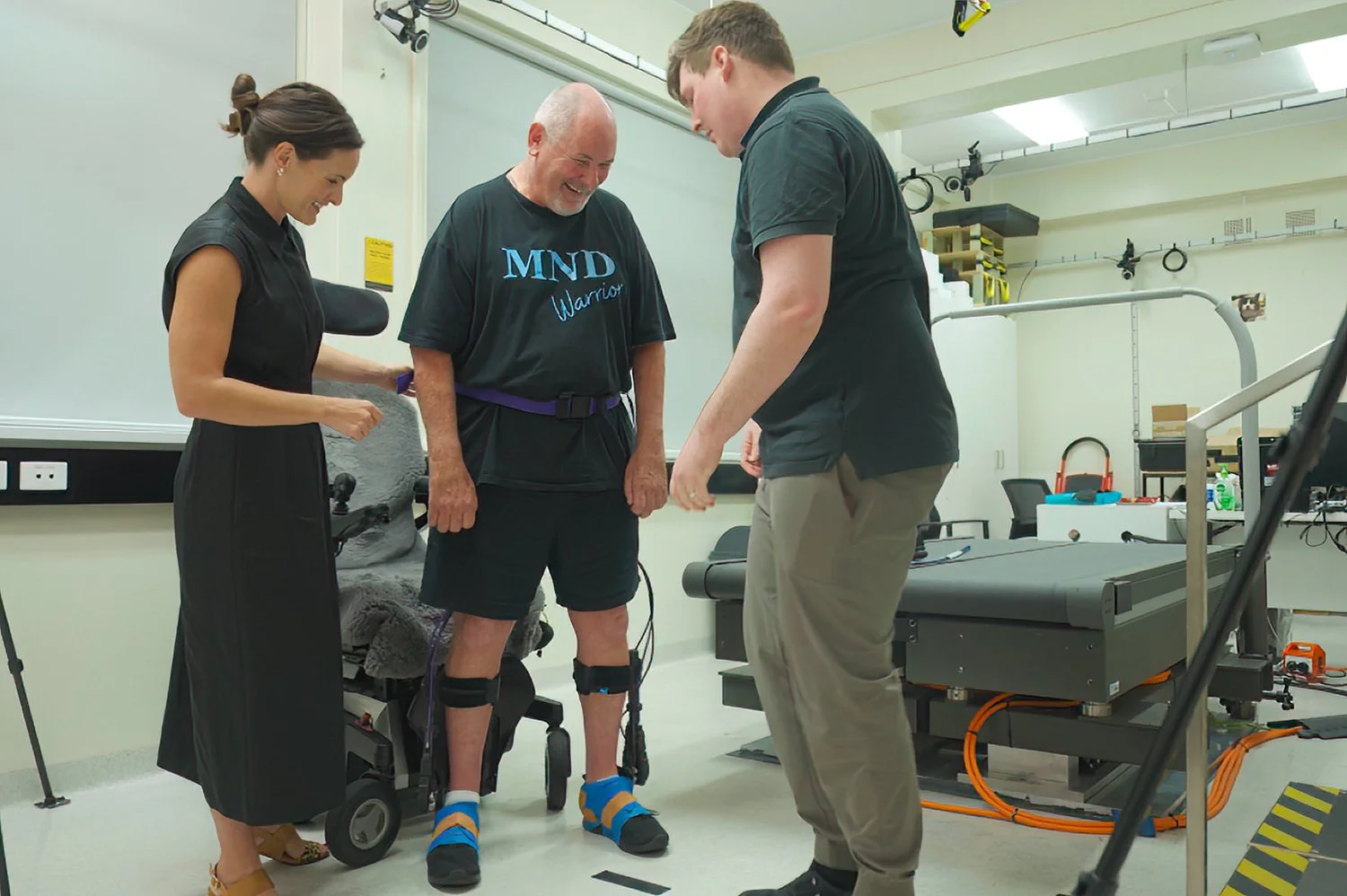
Image Credit: The University of Queensland
The University of Queensland has begun trialling a wearable robotic exoskeleton designed to assist walking in people living with Motor Neurone Disease, also known as ALS in some countries. UQ says the device provides assistance at the ankle joint and is being tested through the iMOVE MND project led by Associate Professor Taylor Dick.




















What Is The Device And Who Is Building It
UQ describes the system as a small waist worn pack that houses the control unit, motors and batteries, linked by cables that transmit force to the ankles. The goal is to make walking easier by adding mechanical assistance at the ankle joint, in a format UQ says is lightweight, portable and untethered so it can be tested outside the lab.
UQ also states the trial work is being supported by Dr James Williamson, who is leading the device’s technical development within UQ’s School of Biomedical Sciences.























How It Works Step by Step
According to UQ, the exoskeleton uses sensors to detect force through the foot and then applies mechanical assistance accordingly. UQ says each leg has a small motor that supports plantarflexion and dorsiflexion, meaning ankle motion that helps drive push off and foot clearance, and the assistance is applied on every step.
This is important from an AI and lifestyle technology angle because it is already a closed loop system: sensing, decision making, and actuation repeating with each gait cycle.
























Where Machine Learning Fits in The Roadmap
UQ says the team is developing a second generation version with improved sensors and machine learning to personalise assistance. The intent, as described by UQ, is to make the assistance more specific, comfortable and easy to use, supporting use beyond short lab visits.
Personalisation matters because gait changes widely between individuals and can shift over time with fatigue, terrain, footwear, and disease progression. UQ also says its next steps include testing the exoskeleton over longer timeframes, to understand how performance changes over weeks and months as the disease progresses.





























What Is Known So Far About Outcomes
UQ reports early participant feedback suggesting an immediate perceived mobility improvement for some users, and shows the system being demonstrated by trial participant Robert Taylor in UQ settings.
For early quantitative signals, a conference abstract from the iMOVE MND program (presented at a 2025 MND Australia PACTALS meeting) reports preliminary testing in 10 people living with MND using ankle exoskeleton assistance (SPARK by Biomotum Inc). In that abstract, the exoskeleton condition is associated with increased preferred walking speed by 0.13 ± 0.03 m/s, faster 4 metre walk time by 0.18 ± 0.06 seconds, and greater 2 minute walk distance by 10.8 ± 3.7 metres, alongside lower perceived exertion on a Borg scale and high reported satisfaction.
Because this is a conference abstract rather than a full peer reviewed paper, it is best treated as an early progress snapshot, useful for direction but not yet definitive.























How This Compares with Similar Exoskeleton Approaches
Ankle assist wearables sit in a different category from many clinic focused full lower limb exoskeletons. For example, Ekso Bionics describes EksoNR as a robotic exoskeleton designed for use in a rehabilitation setting, and the company states it is not available for personal home use outside certified centres.
By contrast, the ankle focused approach UQ describes is aimed at day to day mobility support rather than supervised gait retraining alone, and UQ explicitly frames its priority as helping people maintain walking function and independence as the disease progresses.
On the device side, Biomotum’s published description of its SPARK system aligns with the general architecture discussed by UQ: a waist unit for controls and battery plus leg units providing ankle motion, using pressure under the foot to modulate ankle torque. Biomotum also lists key specifications such as torque range, weight, and approximate runtime.

























Why The Machine Learning Plan Is Credible in 2025
UQ’s machine learning personalisation goal fits a broader trend in wearable mobility tech: moving from fixed assistance profiles to adaptive control based on wearable sensing and user intent. A 2025 Nature Communications perspective highlights advances in wearable sensing and multimodal fusion for intent recognition and adaptive control across exoskeletons and related assistive systems.
There is also strong peer reviewed precedent for data driven personalisation outdoors. A 2022 Nature paper reports a data driven method using wearable sensors to optimise portable ankle exoskeleton assistance in real world walking, finding faster optimisation than lab based approaches and measurable improvements in speed and energy cost in that study’s setting.

























What to Watch Next
Key credibility checkpoints for readers over the next phase will be:
peer reviewed publication of trial methods and outcomes, including safety reporting and participant characteristics
evidence that personalisation improves outcomes beyond a fixed assistance profile, especially across fatigue and varied terrain
clarity on usability factors that affect lifestyle adoption, including comfort, setup time, battery life, and real world reliability
how the machine learning approach is validated, monitored, and updated as user needs change over time
UQ also describes the device as first of its kind in Australia and a world first to trial it in participants with MND. That claim is attributed to UQ’s statement and would typically need broader independent mapping of global trials to fully verify.
























Source: MND Australia, Eksobionics, Biomotum, Nature, NLM, UQ

















 TheDayAfterAI News
We are a leading AI-focused digital news platform, combining AI-generated reporting with human editorial oversight. By aggregating and synthesizing the latest developments in AI — spanning innovation, technology, ethics, policy and business — we deliver timely, accurate and thought-provoking content.