
AI Stock Showdown: 6 Chatbots Predict SanDisk (SNDK) Post-Earnings

Disclaimer: This article is for informational and educational purposes only. The predictions and analyses presented herein were generated by AI systems and should not be construed as financial advice, investment recommendations, or solicitations to buy or sell any securities. Stock prices are inherently unpredictable, and all investments carry risk of loss. Past performance does not guarantee future results. Readers should consult qualified financial advisors before making any investment decisions. TheDayAfterAI News and its contributors do not accept liability for any losses arising from reliance on this content.
In an unprecedented experiment to evaluate the analytical capabilities of leading AI chatbots, TheDayAfterAI News tasked six prominent AI assistants with predicting SanDisk Corporation (NASDAQ: SNDK) stock performance over a five-day trading period following the company’s explosive Q2 FY2026 earnings announcement. The results reveal fascinating divergences in methodology, risk assessment, and ultimate price targets — offering valuable insights into how different AI systems approach complex financial analysis.

















The Setup: A Perfect Storm for AI Analysis
SanDisk delivered what analysts are calling one of the “most explosive” earnings reports in recent US stock market history on January 29, 2026. The company shattered expectations with Q2 EPS of $6.20 (versus consensus estimates of $2.94–$3.78) and revenue of $3.03 billion (versus $2.60–2.69B expected). Perhaps most remarkably, management guided for Q3 EPS of $12.00–$14.00 — implying more than 100% sequential growth.
This created an ideal test case for AI prediction: a stock experiencing extraordinary fundamental momentum, extreme technical overbought conditions (RSI readings of 72–85), and massive price appreciation of approximately 1,400% since its February 2025 spinoff from Western Digital. The prediction period of January 30 to February 5, 2026, would test each AI’s ability to balance bullish fundamentals against technical warning signs.

























The Contenders
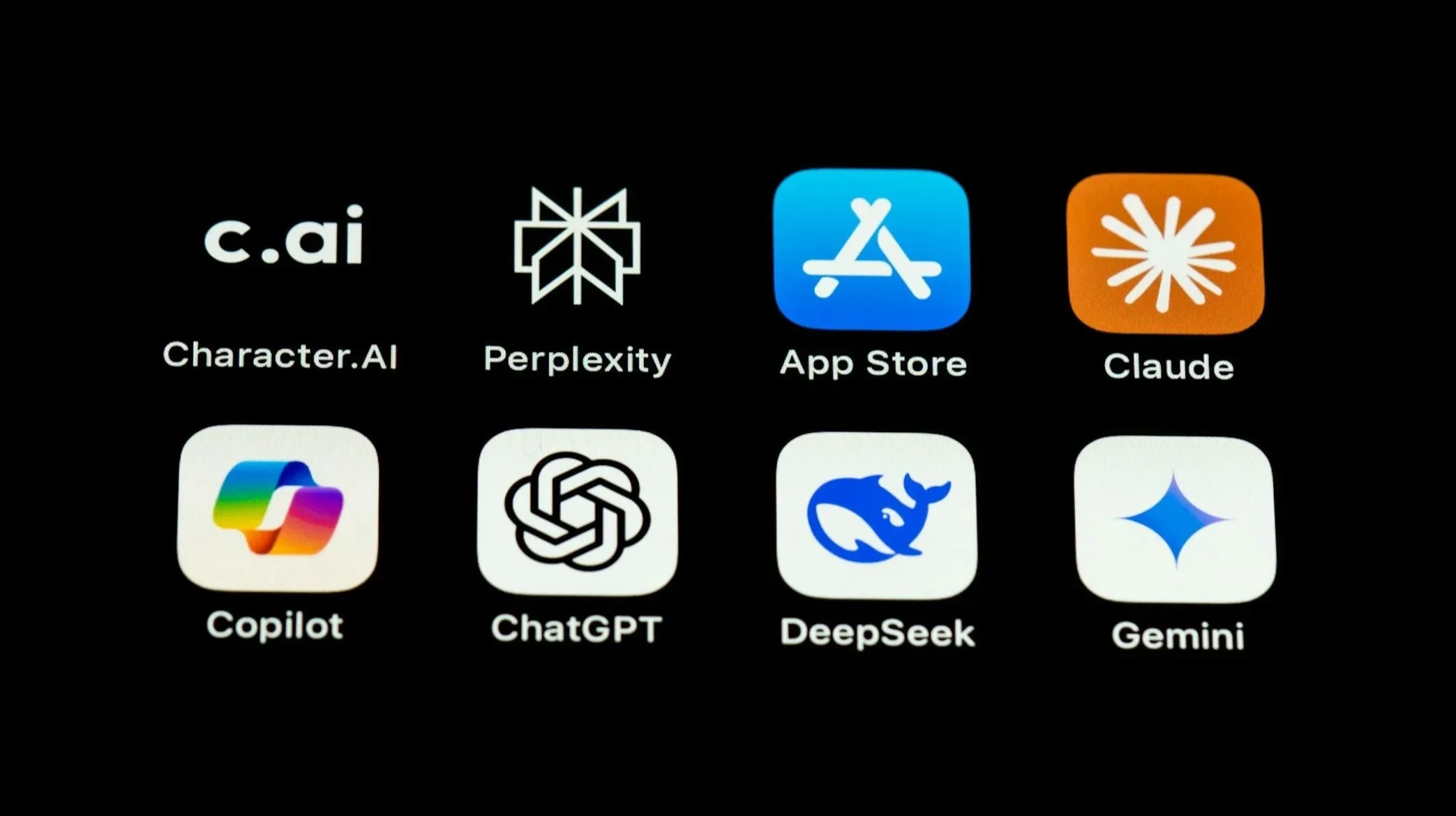
We engaged six leading AI chatbots, each given identical access to publicly available market data, earnings reports, technical indicators, and macroeconomic context. The contenders were: Claude (Anthropic), Gemini (Google), ChatGPT (OpenAI), Copilot (Microsoft), Perplexity, and Grok (xAI). Each was asked to provide predicted opening price for January 30, closing price for February 5, expected trading range, and probability assessments for price direction.























The Predictions: A Comparative Analysis
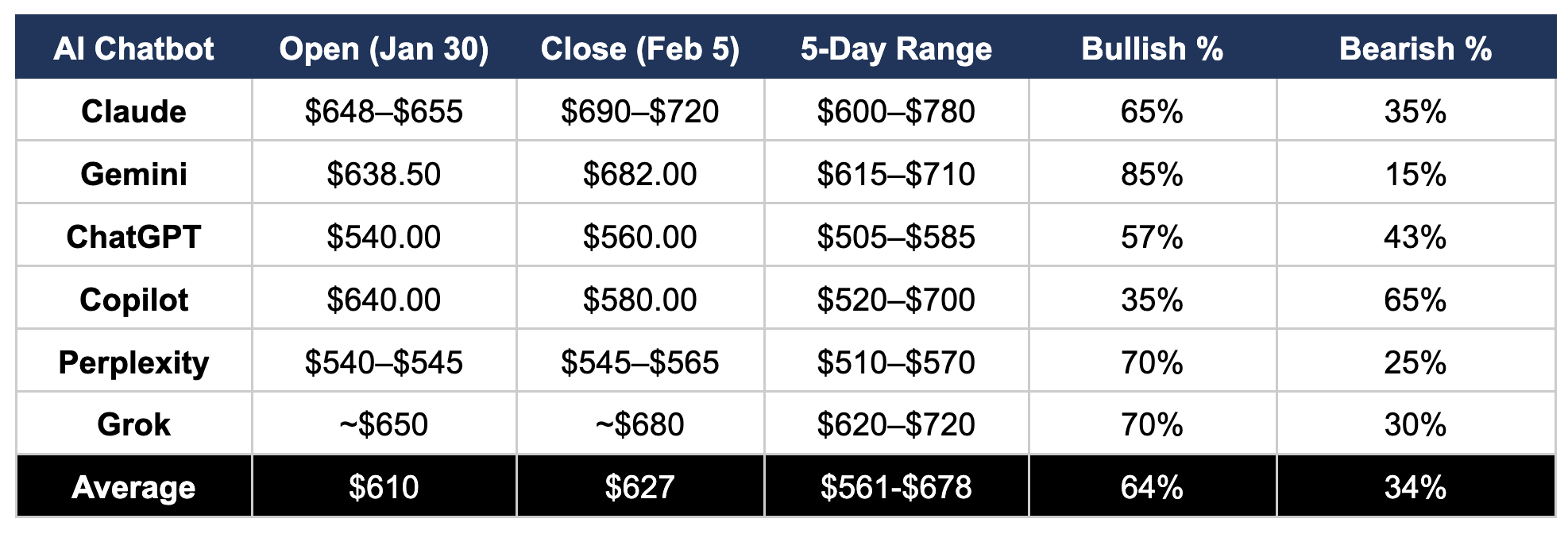
The following table summarizes the key predictions from each AI chatbot:























Key Observations: Where the AIs Diverge
The Bullish Camp: Claude, Gemini, and Grok
Three AI systems — Claude, Gemini, and Grok — converged on aggressively bullish predictions, with expected closing prices in the $680–$720 range. Their analysis heavily weighted the “paradigm shift” thesis: that SanDisk’s extraordinary guidance signals a structural re-rating from commodity cyclical to AI secular growth. Gemini was the most bullish at 85% confidence, arguing that institutional re-weighting and short-covering mechanics would overwhelm traditional overbought signals.
The Contrarian: Copilot
Microsoft’s Copilot stood alone as the sole bearish voice, predicting a decline from $640 to $580 with 65% conviction. Its analysis emphasized post-earnings profit-taking dynamics, options gamma roll mechanics, and the historical tendency for large gap-ups to partially retrace. This contrarian view highlights how different AI systems weight technical versus fundamental factors.
The Conservatives: ChatGPT and Perplexity
Both ChatGPT and Perplexity anchored their predictions much lower, around the $540–$565 range — notably below the pre-market trading levels that other AIs incorporated. This suggests these systems may have weighted earlier data or applied more conservative gap-fade assumptions. Their predicted ranges were also notably narrower, indicating less volatility expectation.



























Methodology Differences: What Each AI Emphasized
The divergence in predictions reveals fundamentally different analytical frameworks. Claude provided the most comprehensive 12-section analysis, balancing technical indicators with fundamental catalysts and assigning probability-weighted scenarios. Gemini focused heavily on market microstructure — short squeeze mechanics, gamma positioning, and ETF rebalancing flows — arguing these systematic factors would dominate price action.
Perplexity delivered a data-rich analysis with extensive citation of source materials, emphasizing overbought technical conditions while maintaining a moderately bullish outlook. Grok provided a concise day-by-day forecast with clear “if-then” checkpoints for monitoring the prediction in real-time. Copilot’s analysis uniquely emphasized the risk of “concentrated gamma” leading to sharp reversals.
























Methodology Differences: What Each AI Emphasized
The divergence in predictions reveals fundamentally different analytical frameworks. Claude provided the most comprehensive 12-section analysis, balancing technical indicators with fundamental catalysts and assigning probability-weighted scenarios. Gemini focused heavily on market microstructure — short squeeze mechanics, gamma positioning, and ETF rebalancing flows — arguing these systematic factors would dominate price action.
Perplexity delivered a data-rich analysis with extensive citation of source materials, emphasizing overbought technical conditions while maintaining a moderately bullish outlook. Grok provided a concise day-by-day forecast with clear “if-then” checkpoints for monitoring the prediction in real-time. Copilot’s analysis uniquely emphasized the risk of “concentrated gamma” leading to sharp reversals.
















Risk Factors Identified Across Analyses
The collective AI analysis surfaced several critical risks including technical exhaustion from extreme RSI and stochastic readings, target exhaustion where current price exceeds most analyst targets, high beta amplification at 2.40x any market weakness, institutional rotation from some large funds reducing positions, and valuation stretch with forward P/E of approximately 26.6x versus peer mean of 18x.



















Conclusion: What This Experiment Reveals
This multi-AI prediction exercise demonstrates both the power and limitations of artificial intelligence in financial analysis. The significant spread in predictions — from Copilot’s bearish $580 target to Claude and Gemini’s bullish $690–$720 range — reflects genuine uncertainty in markets following extraordinary events.
What’s particularly valuable is how each AI’s unique analytical lens illuminates different aspects of the investment case. Used collectively, these perspectives provide a more complete picture than any single analysis. The consensus bullish bias (five of six AIs predicting increases) combined with Copilot’s contrarian caution suggests the weight of evidence favors upside — but with meaningful downside risk if profit-taking accelerates.
For the complete breakdown — including day-by-day price targets, specific option strikes to watch, and detailed institutional flow analysis — please refer to the Full Report.

















License This Article















 TheDayAfterAI News
We are a leading AI-focused digital news platform, combining AI-generated reporting with human editorial oversight. By aggregating and synthesizing the latest developments in AI — spanning innovation, technology, ethics, policy and business — we deliver timely, accurate and thought-provoking content.