
World Bank: 40% of ChatGPT Traffic From Developing Economies Despite 77% Compute Gap
AI-generated Image (Credit: Jacky Lee)
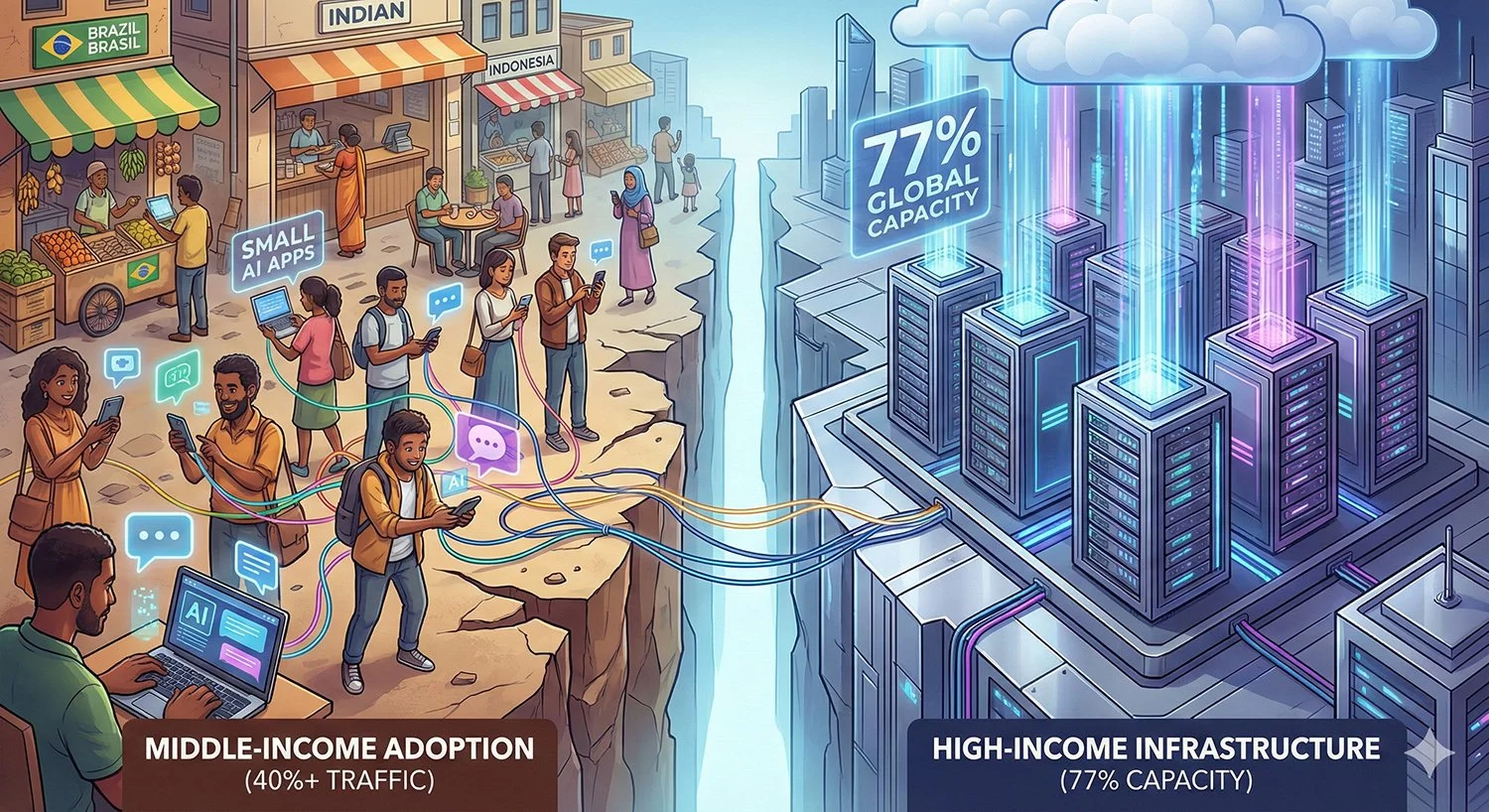
Artificial intelligence is gaining ground in middle-income countries, where more than 40 percent of ChatGPT’s global traffic now comes from users in economies such as Brazil, India, Indonesia and Viet Nam, according to a new World Bank report on the global AI landscape.
The findings, set out in the World Bank’s Digital Progress and Trends Report 2025: Strengthening AI Foundations, describe a fast rise in everyday AI use in developing economies, even as structural gaps in infrastructure, skills and investment persist. The report warns that without targeted policies, those gaps could harden into a deeper global digital divide. Middle- and low-income countries currently account for only about 23 percent of global data centre capacity, with high-income states hosting the remaining 77 percent.



























Surge in Everyday AI Use Signals Broader Shifts
The World Bank highlights ChatGPT traffic as a proxy for grassroots engagement with generative AI. By mid-2025, more than 40 percent of global ChatGPT visits originated in middle-income countries, led by Brazil, India, Indonesia and Viet Nam.
External web-analytics estimates support this pattern. Data based on Semrush and Similarweb show that India now accounts for roughly 9 percent of global ChatGPT traffic, while Brazil contributes around 5 percent and Indonesia about 3–4 percent, placing these economies among the top ten user bases worldwide.
An OpenAI analysis of ChatGPT usage between late 2023 and mid-2025 found that adoption growth in the lowest-income countries was more than four times faster than in the highest-income group over that period. The company links this to cheaper mobile data, broader language support and the availability of free or low-cost tiers.
At the same time, basic connectivity remains uneven. The World Bank notes that 93 percent of people in high-income countries use the internet, compared with 54 percent in lower-middle-income and just 27 percent in low-income economies. That means generative AI is increasingly used by students, professionals and entrepreneurs in major cities, while many rural communities remain largely excluded from these tools.


























Job Market Heats Up, But Skills Lag Behind Demand
On the labour side, the report finds that global job postings mentioning generative AI grew roughly ninefold between 2021 and 2024, with around one in five of these vacancies located in middle-income countries. Roles range from software engineering and machine-learning operations to data annotation and content moderation.
A separate PwC Global AI Jobs Barometer 2024 study shows that sectors with higher exposure to AI technologies have seen labour productivity grow about 4.8 times faster than less-exposed sectors in recent years, underscoring why firms in large middle-income economies are investing in automation and AI-assisted workflows.
However, digital skills remain a binding constraint. According to the World Bank, fewer than 5 percent of people in low-income countries possess basic digital skills, compared with 66 percent in high-income countries; middle-income economies sit between these extremes but still lag far behind advanced economies.
The International Labour Organization’s research on generative AI and work suggests that clerical and administrative support roles are among the most exposed occupations worldwide, particularly in countries where such jobs already rely heavily on computers. At the same time, many manual and informal jobs in developing economies are less immediately affected, raising the risk of widening gaps between digitally connected workers and everyone else.
























Infrastructure Bottlenecks Threaten Long-Term Gains
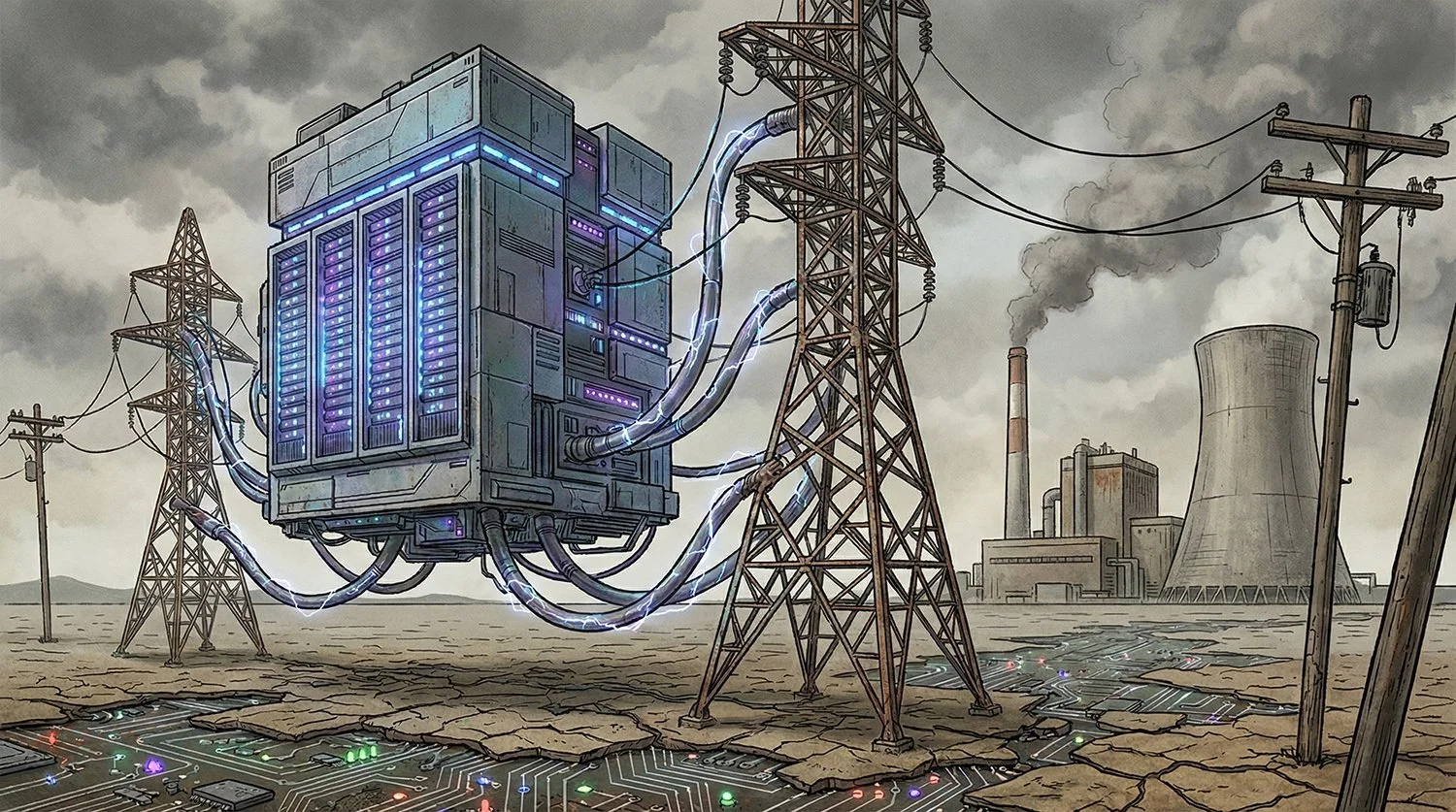
The World Bank emphasises compute and power infrastructure as a critical bottleneck. Drawing on Synergy Research Group data, it estimates that as of June 2025 high-income countries hosted about 77 percent of global co-location data centre capacity, while upper-middle-income countries held 18 percent, lower-middle-income countries 5 percent and low-income countries less than 0.1 percent.
This skew matters because training and deploying large AI models require substantial and reliable compute. The International Energy Agency (IEA) has warned that AI-related data centres could see their electricity demand more than quadruple by 2030, putting additional pressure on grids and complicating expansion plans, especially in emerging markets where power systems are already stretched.
Industry and policy studies point to similar constraints across Asia, Africa and Latin America: grid bottlenecks, delays in connecting new capacity and uncertainty over long-term electricity supply can slow or deter data-centre investment, even as local demand for cloud and AI services grows.
In this context, the World Bank highlights the role of “small AI” – lightweight models and applications that run on everyday devices or modest local servers – as a pragmatic way for developing countries to benefit from AI even without hyperscale infrastructure. Examples in the report include tools for crop monitoring, health diagnostics support and small-business marketing.




















Echoes in Broader Economic Warnings
Other international organisations reach broadly similar conclusions about AI’s economic potential and its distributional risks.
An IMF working paper, “The Global Impact of AI: Mind the Gap”, estimates that AI could raise global GDP by around 0.5 percentage points per year through 2030, while also warning that countries with weaker digital infrastructure and skills may capture far less of these gains.
A separate IMF analysis on AI and energy demand projects that growth in data centres and related infrastructure could lead to a cumulative increase in global greenhouse-gas emissions of about 1.2 percent between 2025 and 2030 under current policies, unless efficiency and clean-energy deployment accelerate.
UNCTAD’s Technology and Innovation Report 2025 forecasts that the global AI market could reach about US$4.8 trillion by 2033 and estimates that AI could affect around 40 percent of jobs worldwide, with significant impacts on lower-skilled roles if social protection and reskilling policies do not keep pace.
The OECD’s Economic Outlook, Interim Report September 2025 projects that global GDP growth will slow from 3.3 percent in 2024 to 3.2 percent in 2025 and 2.9 percent in 2026, as higher tariffs and ongoing policy uncertainty weigh on trade and investment. The report notes that AI and other digital technologies could offset some of this drag if countries invest in skills, competition and open markets for digital goods and services.
Taken together, these assessments echo the World Bank’s message: AI may lift productivity and growth globally, but without deliberate policy action it could also deepen inequalities between and within countries.




























Charting a Path Forward
The Digital Progress and Trends Report 2025 organises its recommendations around four foundational pillars – the “Four Cs”:
Connectivity: expanding affordable, reliable internet access so that more households, schools and firms can use AI-enabled services.
Compute: improving access to data-centre capacity and cloud services, including through regional hubs and cross-border cooperation.
Context: developing local data, applications and governance frameworks so that AI reflects local languages, needs and regulations.
Competency: investing in digital skills – from basic literacy to advanced AI engineering – to ensure workers and institutions can adopt new tools.
World Bank digital director Christine Zhenwei Qiang and her co-authors argue that progress on these foundations will determine whether AI narrows or widens global gaps. In recent public remarks and blogs about the report, she has stressed the rise of “small AI” solutions in agriculture, health and education, and called for stronger partnerships between governments, development banks and the private sector to finance infrastructure and skills in developing economies.













































 TheDayAfterAI News
We are a leading AI-focused digital news platform, combining AI-generated reporting with human editorial oversight. By aggregating and synthesizing the latest developments in AI — spanning innovation, technology, ethics, policy and business — we deliver timely, accurate and thought-provoking content.