
UCLA Develops Optical Generative AI Using Light, Cutting Inference Energy to Millijoules
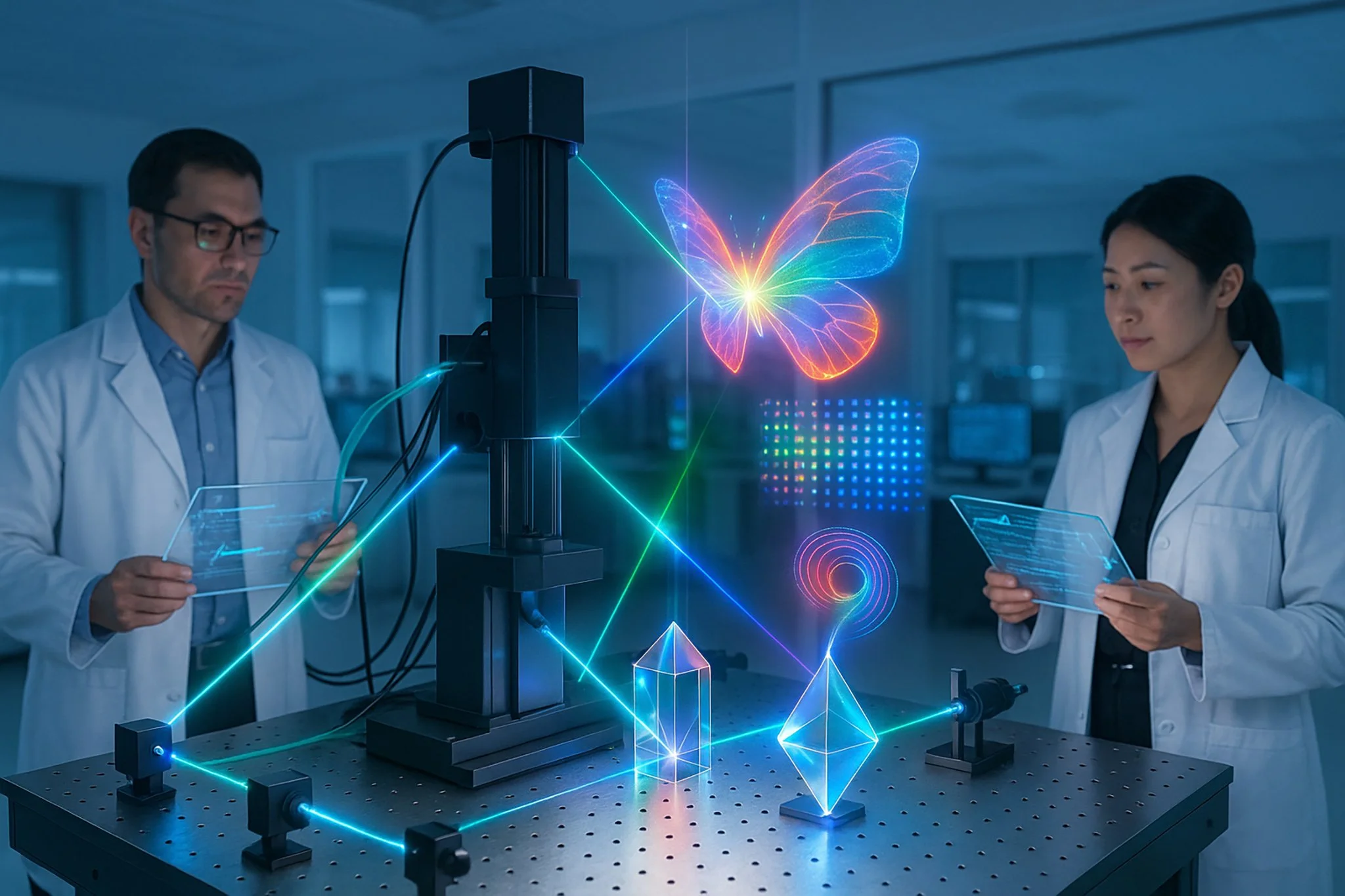
AI-generated Image for Illustration only (Credit: Jacky Lee)
Researchers at the University of California, Los Angeles have developed an optical generative AI system that creates images using light rather than traditional electronic computation, achieving performance comparable to digital neural network based generative models while reducing energy use during inference. This advance, detailed in a paper published in Nature, responds to sustainability challenges in AI by leveraging photonics to minimise power demands.


























The Breakthrough Technology
The system, led by Professor Aydogan Ozcan from UCLAs Samueli School of Engineering, combines a digital encoder with an optical decoder to produce images. It draws inspiration from diffusion models, shifting the primary computation to optical hardware for efficiency. Demonstrations include generating handwritten digits, fashion items, and artwork in the style of Vincent Van Gogh, with results also covering butterflies and human faces across evaluated datasets. The AI core involves training via knowledge distillation from a digital model, ensuring the optical output aligns statistically with target data.





























Background and Development
Generative AI gained prominence with tools like ChatGPT and Stable Diffusion emerging around 2022, allowing creation of text and images from prompts. Yet this rise has highlighted environmental concerns, as data centres supporting AI consume substantial electricity and water. Projections from the International Energy Agency indicate global data centre electricity use could reach around 945 terawatt hours by 2030, equating to roughly 2 to 3 percent of worldwide demand, with AI as a key driver. Ozcans team, comprising postdoctoral researcher Jingxi Li and doctoral students Tianyi Gan and Bijie Bai among others, built on prior diffractive optical networks to adapt them for generative tasks, aiming to lessen dependence on power intensive chips.






























How the System Operates
Operation begins with random noise processed by a compact digital encoder to generate optical seeds, which are phase patterns encoding image information. A laser illuminates these on a spatial light modulator, and the beam passes through a diffractive optical decoder – fixed layers that shape the light into an image captured by a sensor. The snapshot mode completes this in a single pass, while the iterative version refines outputs over orders fewer steps than the thousands typical in digital diffusion models. Training uses a digital teacher model to fine tune the optical components for accuracy.


























Energy Efficiency and Broader Impact
Energy use stands out, with optical inference requiring 0.003 to 0.033 millijoules per image in tested cases, far less than joules needed for electronic versions. This efficiency arises from lights parallel processing, avoiding extensive digital iterations. Broader effects include potential reductions in AI related carbon emissions and water consumption in data centres. A built in key lock feature, using specific wavelengths for decoding, enhances security against unauthorised access. Alexander Lvovsky from the University of Oxford described it as perhaps the first optical neural network producing usable results.
























Potential Applications
Its low power profile fits portable devices like smart glasses or mobiles, supporting real time AI generation in augmented and virtual reality to cut cloud reliance. Potential extends to biomedical areas for quick, energy saving imaging diagnostics, and secure communications via encryption like traits to combat counterfeits. Businesses could apply it for scalable AI in media and entertainment, mitigating typical energy costs.
























Future Trends in Optical AI
Advancements may involve nanofabrication for smaller, affordable devices, blending with conventional computing for hybrid systems beyond imaging. Growing AI needs, coupled with sustainability demands, suggest wider use in edge computing and wearables, though issues like analogue to digital interfaces persist. This work points to a greener path for AI, spurring photonics research to align capabilities with environmental constraints.












































 TheDayAfterAI News
We are a leading AI-focused digital news platform, combining AI-generated reporting with human editorial oversight. By aggregating and synthesizing the latest developments in AI — spanning innovation, technology, ethics, policy and business — we deliver timely, accurate and thought-provoking content.