
AI Country Hit Tops Chart: 24% of Artist Revenue at Risk by 2028
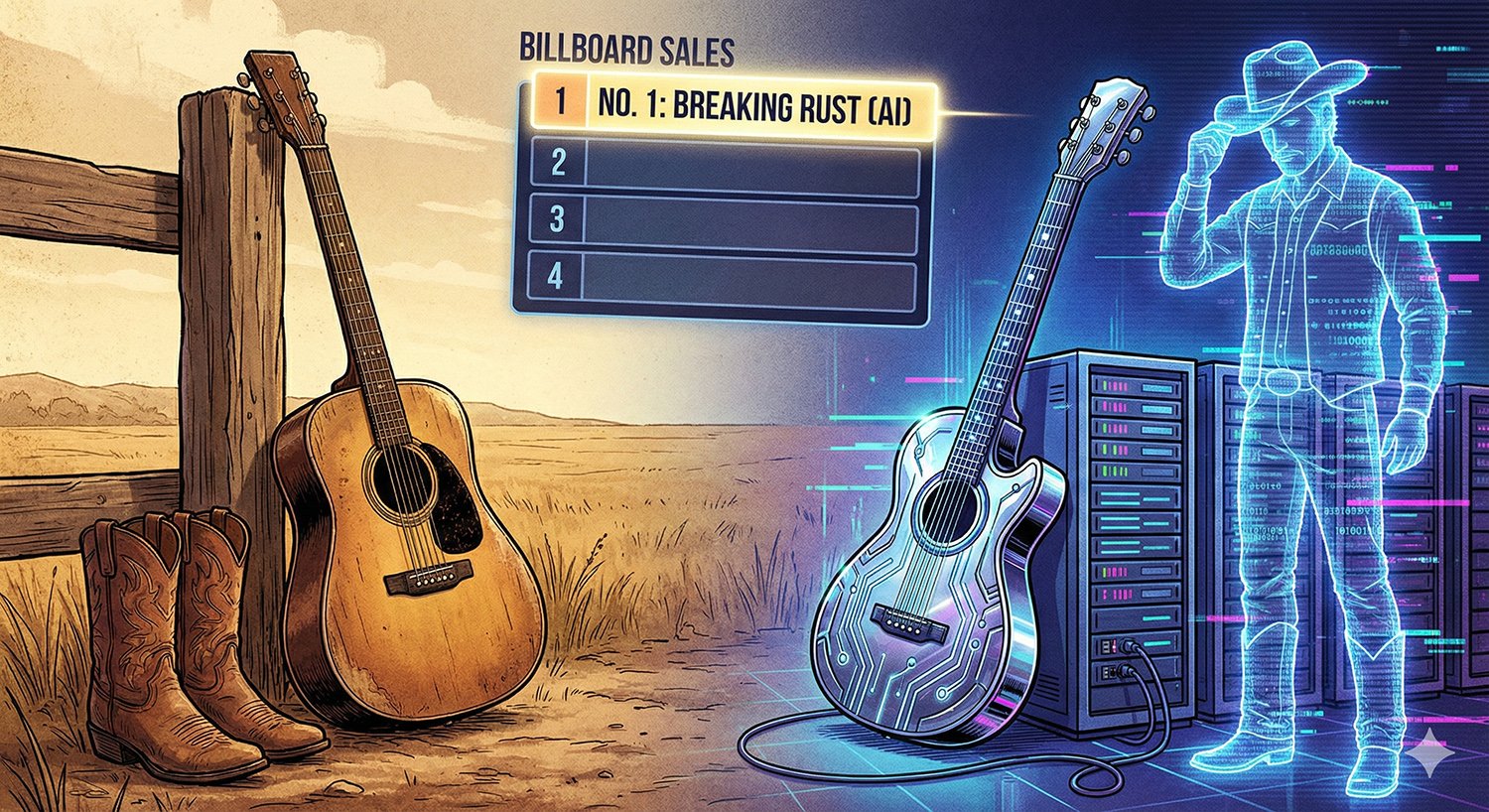
AI-generated Image (Credit: Jacky Lee)
An artificial intelligence-generated country song credited to a fictional artist has reached the top of Billboard’s Country Digital Song Sales chart, underscoring how quickly synthetic music is entering recognized industry metrics and intensifying debates over attribution, consent and protection for human artists.
“Walk My Walk”, released under the virtual act Breaking Rust, hit No. 1 on Country Digital Song Sales for the chart dated November 8, 2025, according to widely cited reporting. The achievement is significant but also easy to misread: this is a paid-download ranking, not a streaming- or airplay-driven measure of the biggest country song overall. Commentators noted that viral posts briefly overstated its broader chart dominance, even though the digital sales milestone itself is real.
Breaking Rust is presented online as a rugged, dystopian-tinged AI cowboy rather than a touring musician. Reporting identifies Aubierre Rivaldo Taylor as the creator credited behind the project, with additional associations to other AI-music personas and online activity.



















Origins and Ascent of a Synthetic Hit
The track’s early traction appears to have followed a familiar 2025 playbook: short-form social platforms help a niche act build recognition, and even modest communities can convert that attention into purchases where the competitive threshold is relatively low. In this sense, “Walk My Walk” illustrates how AI-native music can exploit the same viral mechanics as human acts — just with far fewer barriers to production and release.





























Chart milestone — and a Clarification of Scope
The rise of “Walk My Walk” has sparked confusion because No. 1 status on a digital download chart does not equal dominance across country’s more influential, multi-metric rankings that incorporate streaming and airplay. Analysts say the episode nonetheless matters as a visible test of how AI-fronted acts can mobilise niche purchasing power and social media reach.















Echoes of Blanco Brown Raise Consent Concerns
The Associated Press reports that “Walk My Walk” closely mirrors the vocal style and phrasing of Blanco Brown, the Grammy-nominated artist behind the 2019 hit “The Git Up,” who learned of the song only after friends alerted him. The episode has reignited concerns about the ethical and cultural implications of AI avatars that appear to borrow recognisably from living artists without clear permission or credit.
Brown has since responded by recording his own version of the song and signaling he intends to use the moment to push for clearer rules around voice and stylistic rights in the AI era.
















Comparisons to Fellow AI Chart Climbers
Breaking Rust is not the only AI-country name to appear in the downloads ecosystem. Reporting notes that another AI act, Cain Walker, also charted multiple songs in the same category, suggesting a small but growing pattern of AI-native releases using targeted communities and online visibility to compete in narrow sales lanes.















Implications for an Evolving Industry
The label and platform environment is shifting quickly. After major music companies sued leading AI music generators in 2024, 2025 has seen a pivot toward licensing and partnership frameworks. Universal Music Group and Udio announced a settlement and plans for a licensed AI creation platform aimed at launching in 2026. Warner Music Group has also reached a deal with Suno, reflecting the industry’s move toward negotiated governance rather than relying solely on litigation.
Suno’s status as a major generator has been reinforced by its latest financing: the company announced a USD 250 million Series C on November 19, 2025, at a USD 2.45 billion post-money valuation, superseding earlier, lower valuation chatter from the exploratory fundraising phase.
Meanwhile, streaming services are confronting scale. Deezer says it now receives more than 50,000 fully AI-generated tracks per day, about 34% of daily uploads, although such tracks still represent a smaller share of total listening. Its research with Ipsos indicates most listeners struggle to reliably distinguish fully AI-generated music from human-made tracks in controlled tests, strengthening calls for clearer disclosure and provenance signals.
A separate economic warning from CISAC projects that 24% of music creators’ revenues could be at risk by 2028 if AI output continues to expand without robust compensation structures.













Guardrails and Hybrid Horizons
Regulators have begun to respond unevenly. Tennessee’s ELVIS Act, which expanded protections against unauthorized AI voice and likeness uses, took effect July 1, 2024 and is frequently cited as an early state-level template. At the federal level, proposals such as the NO FAKES Act continue to attract high-profile support while also drawing criticism over scope and speech implications.
For country music, the Breaking Rust episode lands at a cultural crossroads. Even if the Billboard milestone reflects a narrow download category, it signals that AI-generated acts can now compete for real chart visibility and consumer spend. Whether this becomes a short-lived novelty or a durable new lane will depend on how aggressively platforms, lawmakers and labels enforce consent, disclosure, and attribution standards — and whether audiences continue to value human provenance in a genre built on lived-storytelling traditions.





















Source: People, Time, AP News, Axios, UMG, The Guardian, Suno, Deezer Newsroom, CISAC, Armstrong Teasdale, US Congress












 TheDayAfterAI News
We are a leading AI-focused digital news platform, combining AI-generated reporting with human editorial oversight. By aggregating and synthesizing the latest developments in AI — spanning innovation, technology, ethics, policy and business — we deliver timely, accurate and thought-provoking content.