
6 AI Chatbots Predict Alphabet (GOOGL) Price Following 2026 Capex Shock
Disclaimer: This article is for informational and educational purposes only. The predictions and analyses presented herein were generated by AI systems and should not be construed as financial advice, investment recommendations, or solicitations to buy or sell any securities. Stock prices are inherently unpredictable, and all investments carry risk of loss. Past performance does not guarantee future results. Readers should consult qualified financial advisors before making any investment decisions. TheDayAfterAI News and its contributors do not accept liability for any losses arising from reliance on this content.
In this instalment of our ongoing AI Stock Prediction Series, TheDayAfterAI News put six of the most widely used AI chatbots to the test: Gemini, ChatGPT, Grok, Perplexity, Claude, and Copilot. Each was given the same brief — analyse Alphabet Inc. (NASDAQ: GOOGL) and forecast its stock price over the five trading days from February 5 to February 11, 2026.
This week’s prediction challenge arrives at a particularly dramatic moment. Alphabet just reported blockbuster Q4 2025 earnings — beating estimates on both revenue ($113.8B) and EPS ($2.82) — yet simultaneously shocked the market with 2026 capital expenditure guidance of $175–$185 billion, nearly double the prior year. The result: pre-market trading on February 5 showed the stock down roughly 3–4% from its February 4 close of $333.34, creating a rare test case where strong fundamentals collide head-on with investor anxiety over AI spending intensity.
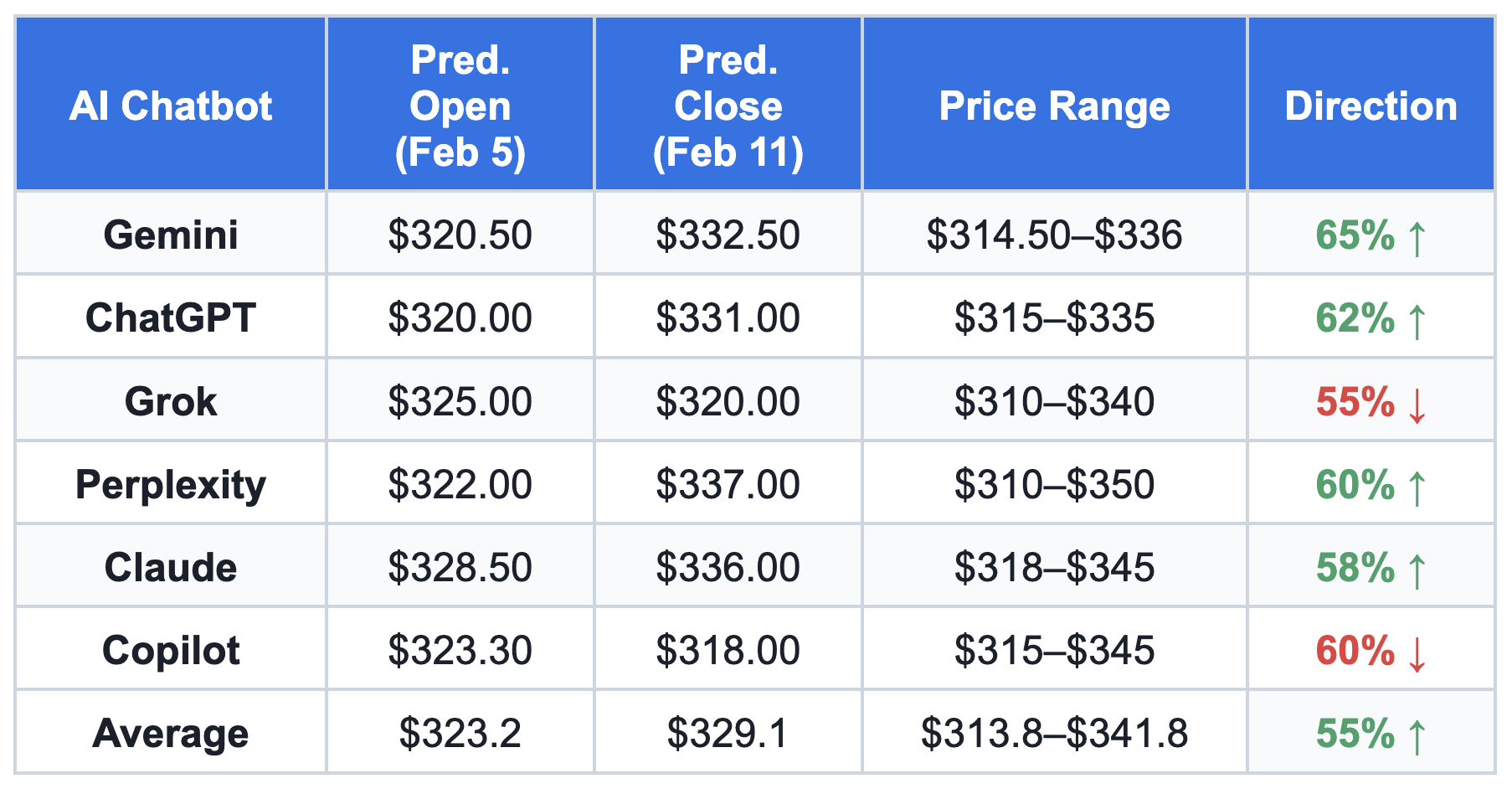
The verdict from our AI panel? A divided but cautiously optimistic consensus. Four of six models predict GOOGL will recover from its post-earnings gap-down by February 11, while two models — Grok and Copilot — take a contrarian bearish stance, projecting continued downside pressure. The average expected return across all six models is +1.8% from the predicted opening price, with a consensus bullish probability of approximately 55%.






The Capex Shock That Divided Wall Street
Alphabet’s Q4 2025 earnings call on February 4 delivered a paradox that perfectly encapsulates the current AI investment debate. On one hand, the company reported its first-ever $400 billion annual revenue milestone, with Google Cloud emerging as the standout at $17.7 billion in quarterly revenue (up 48% year-over-year) and operating margins expanding to 30.1%. Search revenue grew 17%, defying predictions that AI chatbots would cannibalise Google’s core business. EPS of $2.82 beat consensus of $2.63 by over 7%.
On the other hand, management’s announcement that 2026 capital expenditures would reach $175–$185 billion — a 55% increase above Wall Street expectations and roughly double the ~$91 billion spent in 2025 — immediately triggered a sell-off. The stock initially dropped 7% in after-hours trading before partially recovering, and pre-market on February 5 showed prices in the $318–$324 range, representing a ~3–4% gap-down from the prior close.
The broader backdrop adds further complexity. The tech sector has been under pressure with the Nasdaq Composite recording four down sessions in five days. Treasury yields are firming with the 10-year at 4.27–4.28%, the VIX is elevated at 18–21, and geopolitical tensions in the Middle East are contributing to a cautious risk-off posture. The week’s economic calendar features the Employment Situation report (delayed to February 6 due to a government shutdown) and the CPI release on February 11 — both potential catalysts for sharp moves in either direction.




















Head-to-Head: Six AI Predictions Compared
The table below presents each chatbot’s core predictions side by side. All models were given equivalent prompts and access to publicly available market data as of February 5, 2026 pre-market.






















The Bullish Camp: Gemini, ChatGPT, Perplexity & Claude
Four of six AI models project that GOOGL will recover from its post-earnings gap-down over the five-day period, though they differ in the magnitude and confidence of that recovery.
Perplexity — Most Bullish (+4.7%)
Perplexity delivered the most optimistic forecast, projecting a close of $337 against an opening of $322 — a robust 4.7% recovery. Its analysis stands out for integrating the Apple-Gemini partnership announced in January 2026, which it views as a transformative catalyst that makes Google “a core AI infrastructure provider for over 2 billion Apple devices.” Perplexity also cited the cooling-but-not-broken momentum indicators and strong dip-buying interest in the $318–$325 zone as drivers for a base-and-rebound scenario. Its wider predicted range ($310–$350) reflects acknowledgment of significant event risk, but the central thesis is firmly bullish.
Gemini — The Detailed Strategist (+3.7%)
Gemini produced the most comprehensive analysis of the group, framing the entire period around what it calls a “Capex-Induced Dislocation” thesis. Its 13-page report includes detailed day-by-day price projections, scenario modelling (bullish/base/bearish with probability weights), and extensive treatment of options microstructure including Max Pain dynamics and gamma exposure. Gemini predicts an opening near $320.50, an initial “flush” toward $314–$318, followed by a progressive recovery to $332.50 by February 11. The report argues that the capex spend is strategically defensive — reducing Nvidia dependency through custom TPU deployment — and that the 48% Cloud growth provides a fundamental floor.
ChatGPT — The Pragmatist (+3.4%)
ChatGPT’s analysis was concise and data-driven, projecting a $320 open recovering to $331 by February 11. Its day-by-day estimates show a measured recovery pattern: $323 on Feb 5, $326 on Feb 6, $327 on Feb 9, $329 on Feb 10, and $331 on Feb 11. ChatGPT notably flagged the Employment Situation report on the final day (noting the shutdown-related calendar shift) as the primary binary risk, and its wider “risk range” of $308–$343 suggests awareness that macro surprises could easily overwhelm the technical picture.
Claude — The Cautious Optimist (+2.3%)
Claude was the most conservative of the four bullish models, predicting an opening of $328.50 (the highest among all six) and a close of $336. Its relatively higher opening price reflects a view that the worst of the after-hours selling had already been absorbed. Claude gave a 58% probability to an increase — the lowest bullish conviction in the group — and uniquely highlighted the DOJ antitrust appeal filed on February 3 as a negative catalyst. It also provided the most detailed risk factor taxonomy, noting the Bitcoin crash to $72,378 as a broader risk-off signal.
















The Bearish Camp: Grok & Copilot
Two models broke from the consensus to predict net declines over the five-day period, though their reasoning differed in emphasis.
Copilot — Most Bearish (−1.6%)
Copilot delivered the most bearish forecast, projecting GOOGL would close at $318 against a $323.30 open — a net decline with 60% conviction. Its analysis placed heavy emphasis on the macro environment, noting that “U.S. futures were trading lower on Feb 5 as investors digested the capex guide and broader tech weakness.” Copilot’s thesis essentially argues that the macro headwinds (CPI risk, elevated options gamma around the Feb 6 expiry, and risk-off sentiment) will overpower the fundamental strength, keeping the stock under pressure through the period.
Grok — Contrarian Bear (−1.5%)
Grok was the other bearish outlier, predicting a close of $320 versus a $325 open. What makes Grok’s analysis distinctive is its emphasis on sector rotation dynamics — it cited $435 million in weekly outflows from tech ETFs and rotation into cyclicals and small caps as structural headwinds. Grok also assigned a notably high 40% probability to a bullish scenario (vs. its 55% bearish base case and just 5% for an extreme bearish outcome), suggesting it views the outcome as genuinely uncertain rather than strongly directional. Its bearish thesis is essentially one of “death by a thousand cuts” — no single catastrophic driver, but a confluence of sector rotation, capex digestion, and macro uncertainty.
























Common Themes Across All Six Models
Despite their differing conclusions, several analytical themes emerged consistently across all six AI chatbots:
The Capex Paradox: Every model identified the $175–$185B capex guidance as the dominant short-term driver, while simultaneously acknowledging the long-term strategic rationale (custom TPUs, vertical integration, competitive moat).
Cloud as the Floor: All six models highlighted the 48% Google Cloud growth as the fundamental anchor preventing deeper declines.
Options Microstructure: Five of six models discussed gamma effects, Max Pain dynamics, and the February 6 options expiry as short-term price constraints.
Macro Binary Risk: All models identified the Employment/CPI data releases as potential catalysts for sharp directional moves, though they disagreed on the scheduling (some cited Feb 6, others Feb 11).
Technical Oversold Bounce: Most models noted that RSI approaching or below 30 historically generates buy signals for GOOGL, supporting the mean-reversion thesis.
Sector Rotation Headwind: All models acknowledged the broader rotation out of mega-cap tech into financials and industrials as a structural constraint on upside.





















Methodology & Analytical Observations
Each chatbot received the same prompt asking for a comprehensive analysis of GOOGL’s 5-day price forecast including predicted opening price, closing price, price range, directional probability, and supporting reasoning. The models were free to structure their responses as they wished, and the differences in approach are themselves revealing:
Gemini produced the longest and most structured report (13 pages), with day-by-day forecasts, scenario probability tables, and detailed derivatives analysis. It provided the most granular treatment of market microstructure.
Perplexity excelled at source citation, referencing over 50 URLs across financial data providers, trading platforms, and news outlets. Its analysis uniquely highlighted the Apple-Gemini partnership as a structural catalyst.
ChatGPT was the most concise, delivering a clean day-by-day forecast with clear if/then scenario drivers. Its brevity was efficient but left less room for nuance.
Claude provided the most balanced risk assessment, with comprehensive upside and downside risk catalogues. It was the only model to prominently flag the DOJ antitrust appeal and Bitcoin’s crash as risk indicators.
Grok offered the most detailed sentiment and positioning analysis, including fund flow data, put/call ratios, and market breadth metrics. It was the only model to discuss a potential head-and-shoulders pattern.
Copilot delivered the most accessible summary, with a clear quick-reference table and practical trading implications. Its analysis was the most cautious about macro headwinds.














Key Events to Watch This Week
The six AI models collectively identified the following events as the critical swing factors for GOOGL during February 5–11:
February 5 (Thu): Amazon Q4 earnings (post-market) — the closest cloud peer. Strong AWS numbers could normalise Google’s capex narrative.
February 6 (Fri): Employment Situation report + weekly options expiry. A soft jobs print supports tech; a strong one pressures yields higher.
February 10 (Mon/Tue): MSCI index review announcement — potential for rebalancing-driven volume spikes.
February 11 (Wed): CPI release — the most significant macro hurdle. A hot print (>0.3% MoM core) would crush the recovery thesis; an in-line print provides relief.



















A Divided AI Consensus in a High-Volatility Week
This week’s GOOGL prediction challenge produced the most divided consensus we have seen in our AI Stock Prediction Series. The 4-vs-2 bullish-bearish split reflects the genuine tension in the market between Alphabet’s exceptional fundamental performance and the near-term anxiety surrounding its aggressive capital allocation strategy.
The bullish majority, led by Perplexity (+4.7%) and Gemini (+3.7%), argues that the market is overreacting to the capex number and that strong Cloud growth, the Apple-Gemini partnership, and oversold technical conditions will drive a mean-reversion rally. The bearish minority, anchored by Copilot (−1.6%) and Grok (−1.5%), counters that macro headwinds, tech rotation, and CPI risk will keep a lid on any recovery attempt.
Which AI models will prove most prescient? We will publish our follow-up accuracy assessment after the trading period concludes on February 11, 2026. In the meantime, this experiment continues to illustrate both the capabilities and limitations of AI-generated market analysis — these models can synthesise vast amounts of data with impressive speed and structure, but short-term stock price prediction remains one of the most humbling challenges in finance.
For the complete breakdown — including day-by-day price targets, specific option strikes to watch, and detailed institutional flow analysis — please refer to the Full Report.














License This Article








 TheDayAfterAI News
We are a leading AI-focused digital news platform, combining AI-generated reporting with human editorial oversight. By aggregating and synthesizing the latest developments in AI — spanning innovation, technology, ethics, policy and business — we deliver timely, accurate and thought-provoking content.